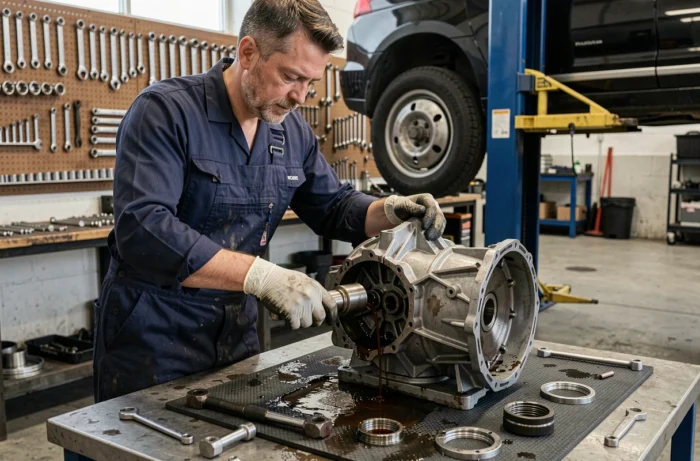
On a high-mileage vehicle, shifting gears becomes difficult, jerks multiply at startup, and one starts to wonder if the gearbox is about to fail. Before budgeting for a replacement, the problem often stems from degraded oil that has never been properly flushed.
Cleaning and flushing the gearbox remains an unknown operation, yet it can restore flexibility to a tired transmission, whether manual or automatic.
Oil residues trapped after draining: the problem that a simple flush does not solve
When draining a gearbox by gravity, most of the used lubricant is recovered. The rest, trapped in the internal channels, between the gears, in the housing, and around the synchronizers, does not come out. This residual volume can represent a significant portion of the total volume.
This leftover used oil contains metallic abrasion particles, aging deposits, and sometimes accumulated moisture. Mixing this residue with fresh oil immediately degrades the new lubricant. We lose viscosity, anti-wear properties, and the drain does not achieve its goal.
This is precisely why a complete gearbox cleaning and flushing changes the game compared to a simple drain. The flushing detaches and removes these residues that gravity alone cannot extract.
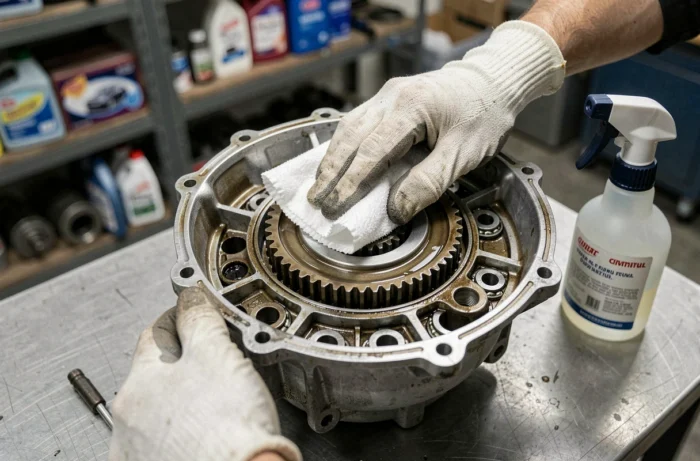
Gearbox flushing: protocol adapted to the level of contamination
A gearbox in good overall condition is not flushed the same way as a contaminated gearbox after tens of thousands of kilometers without maintenance. The technical document from Klüber Lubrication distinguishes three levels, and this graduated approach makes sense in the workshop.
Clean gearbox: direct drain
If the drained oil has a correct color, with no visible deposits or burnt smell, we proceed simply. We drain the hot oil (fluidity facilitates evacuation), inspect the accessible gears, replace any filters, and then fill with the appropriate new lubricant.
Moderately contaminated gearbox: flushing with cleaning oil
When dark deposits appear on the magnetic plug or the oil is very dark, an intermediate flush is necessary. The protocol consists of:
- Draining the hot oil, then filling with a specific flushing oil (not just any lubricant)
- Running the gearbox empty for 30 to 60 minutes to detach internal deposits
- Draining this flushing oil, inspecting the gears, replacing filters, and then filling with the final oil
The empty flushing lasts at least 30 minutes to be effective. Shortening this step leaves suspended residues that will fall back into the new oil.
Heavily contaminated gearbox: prolonged chemical cleaning
For a severely neglected gearbox, with hardened deposits or already degraded operation, the approach changes radically. We drain part of the oil (about one-tenth of the volume), top up with an appropriate cleaning solvent (like Varnasolv), and run the gearbox under normal conditions for 24 to 48 hours. The solvent gradually dissolves the stubborn deposits that conventional flushing oil cannot remove.
After this phase, we drain everything, inspect, and return to a standard flushing protocol if necessary before the final fill. Feedback varies on the number of cycles needed, as it all depends on the initial condition of the gearbox.
Automatic gearbox and so-called “lifetime” oil: the trap of zero maintenance
The vast majority of new cars sold in France are now equipped with an automatic gearbox. And many drivers believe that their transmission requires no maintenance because the manufacturer talks about “lifetime” oil.
Manufacturers of gearboxes like Aisin or ZF, however, recommend regular drains. For the EAT8 gearbox, which is very common in Peugeot vehicles, Aisin recommends a drain every 60,000 to 80,000 km, while the manufacturer’s official recommendations remain more vague or spaced out.
This gap between the manufacturer’s discourse and technical reality has direct consequences. An automatic gearbox oil that is never changed loses its calibrated friction properties, leading to jerks, delayed gear shifts, and then internal mechanical damage. A late drain on a neglected automatic gearbox can even accelerate failure, dislodging deposits that were sealing internal leaks.
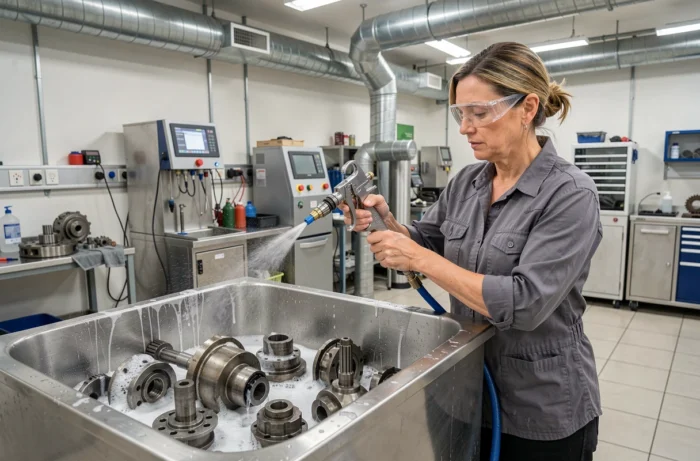
Common mistakes when cleaning a gearbox
In workshops or amateur garages, certain mistakes frequently occur and compromise the entire operation.
- Using an unsuitable solvent (white spirit, household degreaser) that attacks the seals and internal composite materials of the gearbox
- Draining cold, which leaves a much larger quantity of residual oil in the corners of the housing
- Not replacing the gearbox oil filter (when it exists), which amounts to filtering the new oil through a sieve saturated with particles
- Filling with oil of a specification different from that recommended by the gearbox manufacturer, not just the car manufacturer
For automatic gearboxes, an additional mistake is performing a pressure flush on a transmission that is already very degraded. The particles dislodged abruptly can block the solenoids in the valve body. It is preferable to use a flushing method with successive drain cycles, which is gentler.
Flushing frequency and warning signs for the transmission
For a manual gearbox, a flush during each drain (generally every 60,000 to 80,000 km according to manufacturers) is sufficient in most cases. For an automatic gearbox, it is beneficial to shorten the intervals, especially in urban use with frequent stop-and-go situations that put more stress on the torque converter.
Some concrete signs should alert: unusual bearing noise in neutral, increased resistance when shifting to a specific gear, a burnt smell at the gearbox housing, or jerks at low speed on an automatic. A preventive flush costs a fraction of the price of a replacement gearbox.
The key point to remember is that a drain without flushing does not reset the counters. We replace most of the lubricant, but we leave in place the contaminants that accelerate wear. Systematically integrating a flush into transmission maintenance remains the most reliable way to extend its lifespan, whether the gearbox is manual or automatic.