
The Luxembourg real estate market is emerging from two years of price correction. After a marked decline, the indicators available for 2024 and 2025 point towards stabilization, with very different dynamics depending on the chosen segment. Investing in real estate in Luxembourg in 2024 requires understanding these new balances before positioning oneself.
Price gap between new and old in Luxembourg: a structuring choice
Competing content presents the Luxembourg market as a homogeneous block. The reality of prices tells a different story. STATEC data, referenced by several analyses, indicates that in 2025, the average price of existing apartments hovers around 7,773 to 7,800 euros per square meter, while newly constructed apartments (VEFA) are around 10,179 to 10,200 euros per square meter nationwide.
This difference of nearly 2,400 euros per square meter profoundly changes the calculation of a rental investment. New properties show an annual increase of about 10% in 2025, while old properties stagnate, with a variation between 0% and -0.4% depending on the segments.
For an investor targeting rental yield, old properties offer a lower entry ticket and a more favorable rent/purchase price ratio. New properties, on the other hand, focus on medium-term capital appreciation and reduced condominium fees in the initial years. The choice between these two segments depends on the investment horizon and the chosen tax strategy. Specialized platforms like betavi.lu allow for a more refined analysis by comparing the available offers in the territory.

Real estate taxation in Luxembourg: active levers in 2024
The Luxembourg government has introduced several temporary tax measures that modify the profitability calculation of a rental investment. These measures end on December 31, 2024, creating a limited window of action.
- The investor tax credit “Bellenger Akt” reduces registration fees by 20,000 euros per individual, or 40,000 euros for a purchasing couple.
- The accelerated depreciation increases to 6% over six years, allowing a significant portion of the acquisition price to be deducted from taxable rental income in the initial years.
- The capital gains tax rate is reduced to a quarter of the overall rate, making the resale of a rental property significantly less penalizing than before.
These three combined levers reduce the actual acquisition cost and improve net profitability after tax. Accelerated depreciation, in particular, benefits investors who hold the property for six to ten years before selling.
Tax resident or non-resident: distinct rules
An investor residing in France and purchasing in Luxembourg faces the bilateral tax treaty between the two countries. Luxembourg rental income is taxed in Luxembourg, but it is included in the calculation of the effective tax rate in France. This mechanism can neutralize part of the tax advantage if the French marginal rate is high.
Before signing, it is essential to simulate the overall tax impact, not just the isolated Luxembourg tax. A consultant familiar with both jurisdictions remains useful to avoid unpleasant surprises at tax declaration time.
Rental demand in Luxembourg: what supports rents
The population of the Grand Duchy has increased by more than 26% between 2000 and 2024, reaching 672,050 inhabitants. This number exceeds one million during the week due to cross-border workers. This ongoing demographic pressure fuels a structurally higher rental demand than the available housing supply.
Luxembourg hosts European institutions, a dense financial sector, and an investment fund ecosystem that attracts high-income profiles. These tenants accept high rents, securing returns for landlord owners.
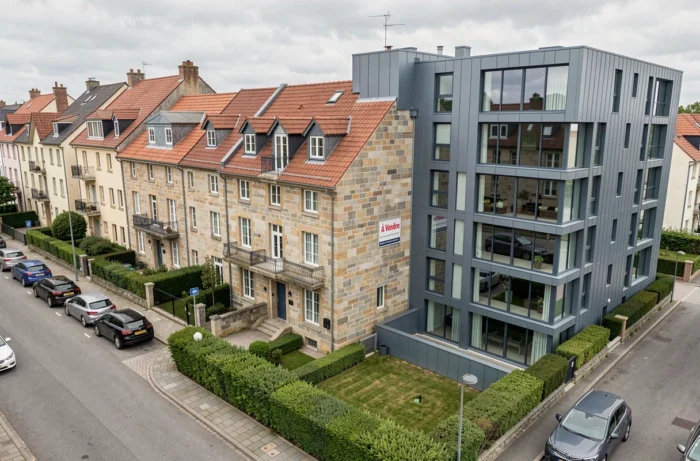
Where rental tension is concentrated
Luxembourg City remains the most strained market, with some of the highest rents in Europe. Peripheral municipalities like Esch-sur-Alzette or Differdange offer more accessible purchase prices while benefiting from sustained rental demand supported by transport links.
The cross-border alternative (Thionville, Mont-Saint-Martin on the French side) attracts investors seeking a lower entry ticket with a clientele of cross-border workers. Prices there are significantly lower, but French taxation applies fully, which alters the net yield.
Real estate investment timing in 2024: why the window matters
The Luxembourg market is no longer in the continuous rise of 2015-2022, nor in the brutal correction phase of 2022-2023. The current stabilization creates a particular context: prices have corrected, but demand fundamentals remain strong.
This configuration is favorable for buyers entering now, provided they do not overestimate the potential for short-term capital gains. The recovery of prices, if confirmed, will likely be gradual.
The temporary tax measures of 2024 add a timing argument. An investment signed before December 31, 2024, benefits from the tax credit, accelerated depreciation, and the reduced rate on capital gains. After this date, there is no guarantee of renewal.
Luxembourg real estate remains a market where gross rental yield remains modest compared to other European capitals, but where political stability, demographic growth, and the depth of the labor pool reduce the risk of rental vacancy. The choice of segment (new or old), location, and tax structuring determine actual profitability much more than the purchase price alone.