
Badminton and table tennis share an obvious common point: a racket, a net, an opponent in front. But from the very first session, the physical feeling and the pace of play are nothing alike. Choosing between these two sports means choosing a radically different relationship with movement, space, and speed.
Physical demands: what your body really feels on the court and at the table
Have you ever played a badminton match in a gym, even casually? Your legs burn, and your breath is quickly taken away. The badminton player goes through short sprints, jumps, and explosive changes of direction. Badminton engages the entire body at high intensity, including the ankles, knees, and shoulders.
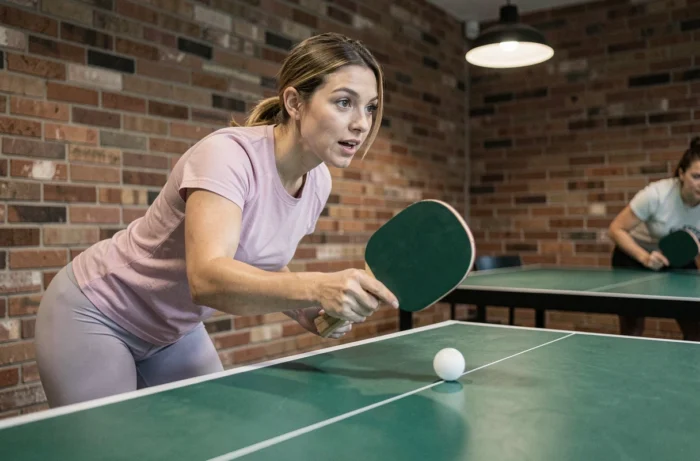
Table tennis, on the other hand, works differently. Lateral movement is limited to a few steps. The main effort focuses on hand-eye coordination, reading the spin of the ball, and reaction speed at the wrist and forearm. You sweat less, but mental concentration is constant.
A point rarely addressed in comparisons: data from a Swedish emergency center shows that recreational badminton generates significantly more lower body injuries (ankles, knees, Achilles tendon) than table tennis. Over 90% of badminton injuries come from recreational play, not competition. Table tennis remains a low-trauma risk sport, making it a relevant choice for people returning to activity after an injury or at an older age.
To delve deeper into the differences between badminton and table tennis, the physical dimension is the first criterion to consider before joining a club.
Racket, shuttlecock, and ball: equipment changes the nature of the game
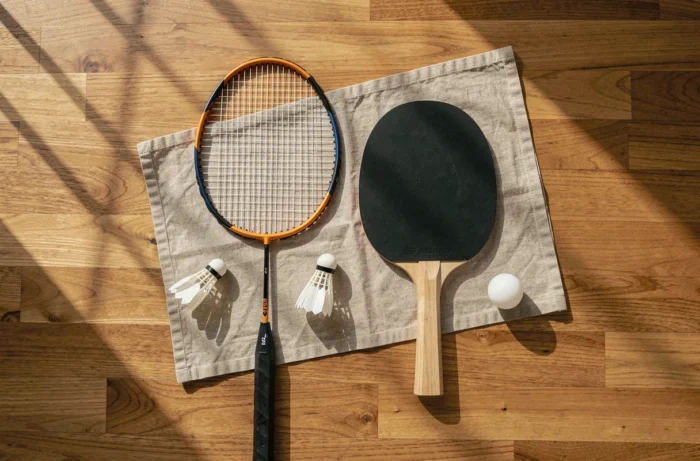
In badminton, the racket is long, light, and strikes a shuttlecock whose trajectory slows down in flight. This unique aerodynamic behavior forces the player to anticipate the curve of descent. The shuttlecock does not bounce: each strike is definitive.
In table tennis, the ball is small, fast, and above all, it spins. The racket’s surfaces (smooth rubber, pips, sponge) directly influence the spin given to the ball. Mastering spin effects is the key to progress in table tennis. An intermediate player spends more time reading the opponent’s spin than hitting hard.
This difference in projectiles creates two philosophies of play:
- In badminton, the power of the smash and the placement of the shuttlecock in the empty areas of the court are the main weapons. The game is spatial, requiring coverage of several meters.
- In table tennis, the variation of spins (chopped, lifted, lateral) and reaction speed take precedence. The game is more tactical and compact, focused on a table less than three meters long.
- Badminton requires a high net (over one meter fifty), which imposes upward strikes and clearances. In table tennis, the net is very low, and low exchanges dominate.
Accessibility and progression: two distinct learning curves
Badminton offers almost immediate playing pleasure. Two beginners can exchange a shuttlecock from the very first session without technical training. The shuttlecock floats enough to allow time to react. This accessibility partly explains the explosion of registrations in badminton clubs observed in France in recent years, to the point that many gyms have waiting lists.
Table tennis is technically more demanding from the very first hours. Holding the racket correctly (European grip or Asian grip known as “penhold”), understanding why the ball goes into the net due to an opponent’s chop, adjusting the angle of the racket to the millimeter: the learning curve is steeper at the start.
However, once the basics are acquired, table tennis allows for regular progress by refining game reading. Badminton, on the other hand, quickly reaches a physical plateau: without good cardiovascular condition and sufficient joint mobility, technical progress stagnates.
Club practice and competition: two different ecosystems
Table tennis benefits from a very structured international framework by the ITTF, with precise rules on service, scoring by sets, and specifications for approved equipment. Local competitions are accessible even to recent players, with rankings by level.
Badminton is more structured around the club and the gym. Outdoor practice remains anecdotal in competition (the shuttlecock is too sensitive to wind). Finding a time slot in a gym can be complicated in cities where demand exceeds the supply of gyms.
Table tennis has a logistical advantage: a table in a garage, a multipurpose room, or an association space is sufficient. Badminton requires a high ceiling and a dedicated court, which limits options for free practice outside of clubs.
Starting budget for each sport
Both sports remain financially accessible. An entry-level badminton racket and a tube of shuttlecocks cost little. For table tennis, a pre-assembled racket with decent surfaces and a set of balls represents a similar investment. The cost difference mainly lies in the rental of the court: renting a time slot in a gym for badminton often costs more than accessing a table in a municipal hall or association.
Ultimately, the choice between badminton and table tennis depends on what you are looking for. A cardio sport, explosive, that works the whole body? Badminton. A precision sport, tactical reading, playable in a small space and with a low risk of injury? Table tennis. The two actually complement each other very well: the wrist agility developed at the table enhances net play, and the endurance gained on the badminton court benefits concentration during a table tennis match.