
A hedge that undulates or leans is immediately noticeable. The eye catches every dip, every bump. Achieving a straight line is not a matter of chance or just a quick glance: it’s a question of method, posture, and a few well-placed physical markers even before starting the hedge trimmer.
Taut line and stakes: the true cutting guide for a straight hedge
You may have noticed that a freehand line always appears less straight than a line drawn along a ruler? The principle is the same for hedge trimming. Planting stakes and stretching a string remains the most reliable method to define the cutting line.
Drive rigid stakes (bamboo, metal supports) at both ends of the hedge, then a third in the middle if the length exceeds a few meters. Tie a clearly visible string at the desired cutting height. This line will serve as a constant reference throughout the work.
The string should not touch the foliage: leave a few centimeters of space between the line and the surface to be cut. If it rubs against the branches, it will shift, and your reference will become useless. To learn how to trim a hedge correctly, this visual marker makes all the difference between a clean result and a rough line.
A level attached to a stake also allows you to check that the string is perfectly horizontal. A few minutes of preparation can save you from having to redo an entire section.
Trapezoidal hedge trimming: why widening the base changes everything
Trimming a hedge perfectly vertical on the sides seems logical. In practice, this rectangular shape poses a problem: the lower part receives less light and becomes sparse over the seasons.
The solution is to give the hedge a slightly trapezoidal profile. The base remains wider than the top. Specifically, each side tilts inward by a few degrees as it rises.
- The foliage at the bottom captures more direct light, which maintains density throughout the height.
- Rainwater drains better towards the roots instead of stagnating on a flat, wide top.
- Snow or frost slides off without crushing the upper branches, reducing the risk of breakage.
This trapezoidal profile applies to both thuja hedges and hornbeam or laurel hedges. A narrower hedge at the top stays dense longer than a hedge trimmed at a right angle.
Posture and movement of the hedge trimmer: mistakes that create waves
The tool alone does not create the line. How you hold it and how you move your body matters just as much as the string.
Keep arms stable and move by sweeping
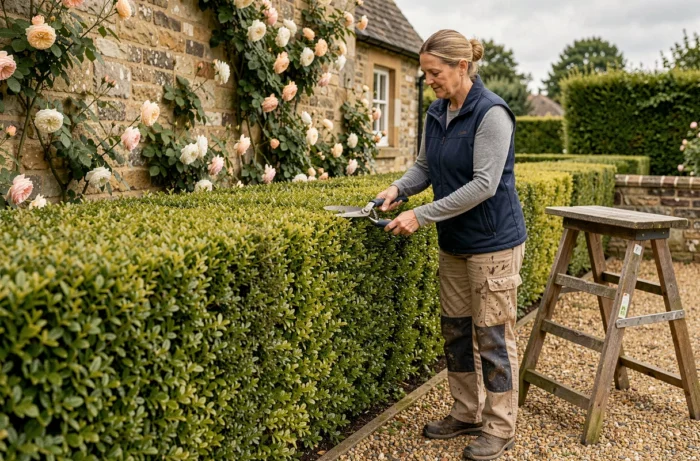
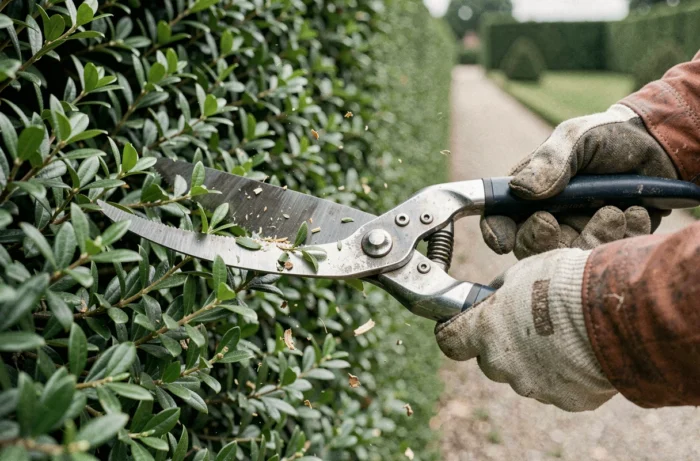
The basic gesture consists of moving the blade parallel to the surface of the hedge, in a wide and steady motion. Each pass should cover the same width. If you shorten the gesture halfway, the cut will be uneven.
Feet advance, arms stay at the same height. A common mistake is to pivot the torso while staying in place: this creates an arc instead of a straight line. Walk along the hedge while keeping the blade at a constant distance from the foliage.
Start from the top, finish with the sides
First, trim the horizontal surface of the top. This is the most visible area and where irregularities are most noticeable. For this pass, slightly tilt the blade towards you so you can see the cutting line without leaning over the hedge.
Then move to the sides, from bottom to top. Raising the blade allows the fallen leaves and branches to drop naturally, without obstructing the cutting area.
Legal height of the hedge and risk of fines in France
Trimming straight is not just a matter of aesthetics. The height of your hedge in relation to the property line is governed by Articles 671 and 672 of the Civil Code.
Law No. 2025-268 has strengthened this framework. Administrative fines now range from 150 to 750 euros, and the mayor can order trimming at the owner’s expense if the hedge exceeds the authorized thresholds. For plantings located less than two meters from the boundary, the maximum height is generally set at two meters (unless local practices differ).
Maintaining a regular height hedge also helps avoid neighbor disputes. A well-placed string serves both visual straightness and compliance with regulatory thresholds.
Trimming season and wildlife protection: a calendar to follow
Before taking out the hedge trimmer, check that the timing is favorable. Since 2025, the OFB and LPO recommend waiting until the end of August to trim without risking destroying a nest.
Destroying a nest of a protected species, even unintentionally, constitutes an offense. Penalties can be severe. A simple visual check before each trimming session is often enough to spot an active brood: gently part the branches at eye level and observe for a few seconds.
Spring remains suitable for light formative trimming, before the nesting period (generally starting from mid-March). Autumn, after the end of August, is suitable for more substantial trims. Two trims per year are sufficient for most hedge species, one at the end of winter and one at the end of summer.
Trimming your hedge straight relies on three concrete pillars: a marked string, a stable cutting gesture, and a trapezoidal shape that preserves foliage density. Add to that respect for the nesting calendar and legal height thresholds, and your hedge will remain neat without unpleasant administrative surprises.