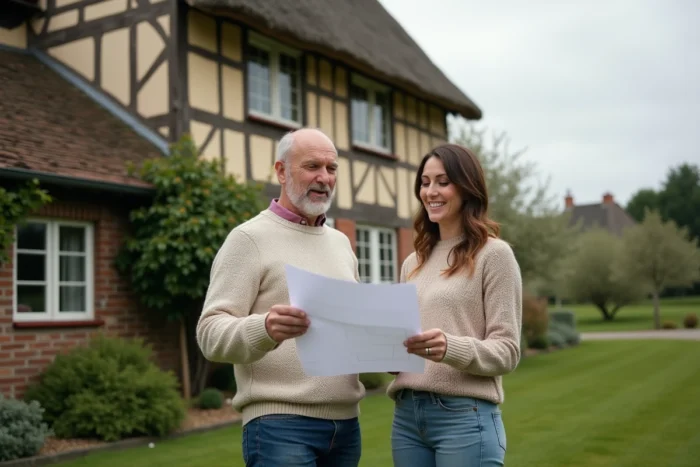
The Normandy real estate market is not just about a trade-off between Caen, Rouen, and Le Havre. The price differences per square meter between micro-sectors within the same urban area, the regulatory constraints related to the coastline, and the specificity of the region’s old buildings create pitfalls that standard analysis grids do not cover. Here, we detail the technical points that determine the success of a real estate project in Normandy.
Coastal Erosion and PLU Zoning: The Invisible Risk on the Normandy Coast
Since the implementation of the Climate and Resilience Law, several coastal municipalities in Normandy are on the prefectural list of areas exposed to coastal erosion. This classification distinguishes two timeframes: a 30-year exposure zone and a 100-year exposure zone. In the first, extensions and elevations may be prohibited. In the second, the very sustainability of the property is questioned in the long term.
Before making any offer on a coastal property, we recommend requesting the precise zoning of the plot in the municipal PLU. A property located a few hundred meters from the shore may very well be outside the zone, while a house seemingly far from the cliff may be included if the soil is clay-limestone and the slope is oriented towards the sea.
This point is often absent from most articles on buying in Normandy, even though it directly affects the medium-term resale value. A buyer who discovers this classification after signing finds themselves with a property that is difficult to finance by banks in the future.

Real Estate Diagnostics in Normandy: What the Regulatory File Does Not Cover
The file of mandatory technical diagnostics (DPE, asbestos, lead, termites according to prefectural orders) provides a partial view of the actual condition of a Normandy house. By following real estate on normandie-libre.fr, one can identify properties whose structural issues are only detected after acquisition.
For old buildings near the coast or in wet areas, three risks escape standard diagnostics:
- The condition of foundations and buried walls, particularly on sloping land or at the foot of cliffs, where underground erosion weakens the footings without visible signs on the surface.
- Capillary rise in limestone or flint walls, common in longères and farmhouses in the Pays de Caux or Bessin, which deteriorates insulation and incurs heavy repair costs.
- Non-collective sanitation, often outdated in rural municipalities, where bringing it up to standard can represent a significant budget not anticipated by the buyer.
We systematically recommend hiring an independent building expert for a complementary inspection, distinct from the regulatory diagnostician. The cost of this expertise remains marginal compared to the risk of structural work post-acquisition.
Rental Investment in Normandy: Balancing Gross Yield and Actual Rental Pressure
Secondary cities in Normandy attract investors seeking yields higher than those in regional metropolises. The reasoning is logical: low entry prices, rents that do not decrease proportionally. In practice, the displayed gross yield often masks an underestimated rental vacancy.
A municipality like Louviers or Elbeuf shows attractive prices per square meter. There is rental demand, driven by the industrial and logistics employment basins of the Seine Valley. However, the profile of tenants (more frequent turnover, higher default rates in certain neighborhoods) alters the actual net yield.
For a rental investment in Normandy, we observe that three parameters require detailed analysis before any commitment:
- The actual rental vacancy rate in the targeted neighborhood, verifiable with local agencies and not based on municipal averages.
- The presence of a stable employment hub (hospital, industrial zone, campus) within twenty minutes, which guarantees a recurring flow of tenants.
- The condition of the competing rental stock: a neighborhood saturated with small renovated units under the Pinel law creates downward pressure on rents that online simulators do not capture.

Old Normandy Buildings: Technical Specificities to Include in the Renovation Budget
Timber framing, flint, cob, slate or thatch roofing: the built heritage of Normandy imposes renovation constraints that standard quotes underestimate. A renovation budget based on Île-de-France ratios will systematically be insufficient for a cob longère in the Pays d’Auge.
Cob, a mixture of earth and straw applied to a wooden frame, requires craftsmen trained in this material. Their availability varies significantly by department. In Calvados and Eure, a few specialized companies work with lead times of several months. In Manche or Orne, the pool is even more limited.
Natural slate roofs, very common in Normandy, are significantly more expensive to renovate than a mechanical tile roof. Synthetic slate remains an option, but some protected areas (ABF perimeters around historical monuments) prohibit it. Checking the architectural prescriptions of the municipality before estimating the roofing costs avoids surprises during the permit phase.
The DPE of old Normandy houses frequently falls within classes E to G. External insulation, a common solution for recent buildings, is rarely compatible with timber-framed or exposed stone facades. Internal insulation remains the only viable option, with a loss of living space to be factored into the profitability calculation.
A real estate project in Normandy that incorporates these parameters from the research phase gains in budgetary realism. Properties to renovate represent a significant part of the regional offer, and their potential remains real, provided that renovation costs are estimated with local craftsmen before signing the compromise.