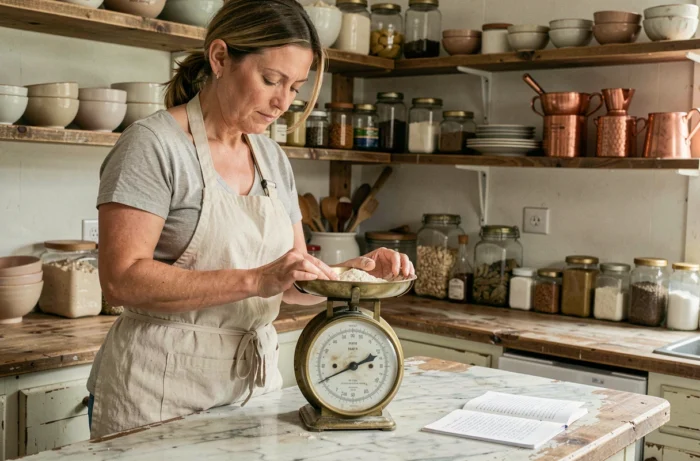
An American recipe calls for 1 cup of flour, another indicates 150 ml of cream, and your scale shows grams. This discrepancy between measurement systems is the primary cause of failures in the kitchen, especially in baking. Mastering the conversion of weights and measures in cooking transforms a foreign or approximate recipe into a reliable result, every time.
Why converting volume to weight changes the outcome of a recipe
Have you ever noticed that a cup of flour does not weigh the same as a cup of sugar? This is because each ingredient has a different density. Water, milk, or broth have a density close to 1: 100 ml is roughly equivalent to 100 g. For these liquids, the conversion is simple.
The problem begins with dry and semi-liquid ingredients. A cup of wheat flour weighs significantly less than a cup of honey. Converting volume to weight without considering density distorts the recipe. This is why simple charts that state “1 cup = 240 ml” without specifying the ingredient can be misleading.
When you follow a baking recipe, a few extra grams of flour or sugar can alter the cake’s texture, its moistness, or its structure. To achieve a reproducible result, the recommendation that is becoming widespread among bakers is clear: weigh dry ingredients to the nearest gram with a precision scale.
Conversion of grams, milliliters, and spoons: practical benchmarks that really help
Rather than a giant chart that’s hard to memorize, focus on a few practical equivalences that cover most situations in everyday cooking. They will be useful for adapting an Anglo-Saxon recipe as well as for cooking without a scale.
- A teaspoon (tsp) holds about 5 ml, which is roughly 5 g of water or milk, but only 3 g of flour
- A tablespoon (tbsp) is equivalent to 15 ml, or 3 teaspoons, and about 10 g of flour or 12 g of sugar
- A standard glass (like a mustard jar) holds about 200 ml, which gives 200 g of water but only about 120 g of packed flour
These discrepancies show why it’s always important to specify the ingredient when converting volume to weight. If you regularly work with recipes in cups or ounces, you’ll save time by consulting the weight converter on Double Portion, which details the correspondences by ingredient.
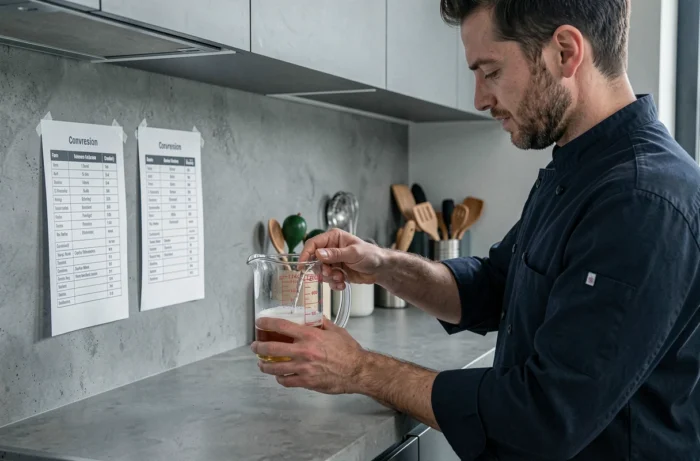
Conversion of oven temperatures: thermostat, Celsius, and Fahrenheit
French recipes use the thermostat or degrees Celsius, while American and British recipes display Fahrenheit. Confusing the two risks a burnt dish or one that is barely warm.
The principle for converting the thermostat is the easiest to remember. Multiply the thermostat number by 30 to get the temperature in Celsius. Thermostat 6 is 180 °C. Thermostat 7 is 210 °C.
To convert from Fahrenheit to Celsius, the formula is less intuitive: subtract 32, then multiply by 5 and divide by 9. In practice, remember these common benchmarks:
- 350 °F corresponds to about 175 °C (thermostat 6), the classic temperature for a cake
- 400 °F corresponds to about 200 °C (thermostat 7), used for gratins and roasted meats
- 450 °F corresponds to about 230 °C (thermostat 8), suitable for pizzas and thick-crust breads
If your oven only displays the thermostat and your recipe indicates Celsius, the reverse rule works: divide the temperature in Celsius by 30 to find the thermostat.
Density-based conversion applications: beyond static charts
Classic conversion charts have a limitation: they fix an average value for an ingredient without considering granularity or packing. Sifted flour does not occupy the same volume as flour taken directly from the package.
Recent mobile applications address this issue by integrating density databases by ingredient. The Tare: Kitchen Companion app, for example, relies on over 310 ingredients with verified densities to automatically convert cups, spoons, or milliliters into grams. Others, like Kitchen Converter or Math & Muffins, also offer automatic recalculation of quantities based on the size of the mold.
This type of tool goes far beyond a simple correspondence table. When you halve a recipe or change molds, the risk of calculation error is real. A converter that takes density into account avoids approximations on the most sensitive ingredients: flours, sugars, fats, honey.
When the scale remains necessary
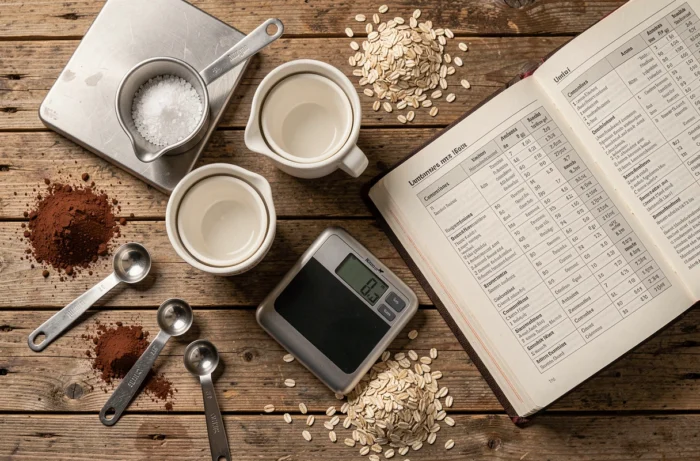
Despite the increasing quality of these tools, a precision scale remains the most reliable way to measure dry ingredients. Volume-to-weight conversions are approximations, even good ones. In baking, where the margin for error is small, weighing directly in grams eliminates any uncertainty.
For everyday savory cooking (soups, sauces, marinades), spoons and measuring glasses are more than sufficient. The precision issue is not the same when adding salt to a soup or when measuring the yeast for a brioche.
Adapting your method to the type of preparation is the real reflex to acquire. Scale for baking, spoons and measuring glass for the rest: this distribution covers almost all situations without unnecessary equipment.