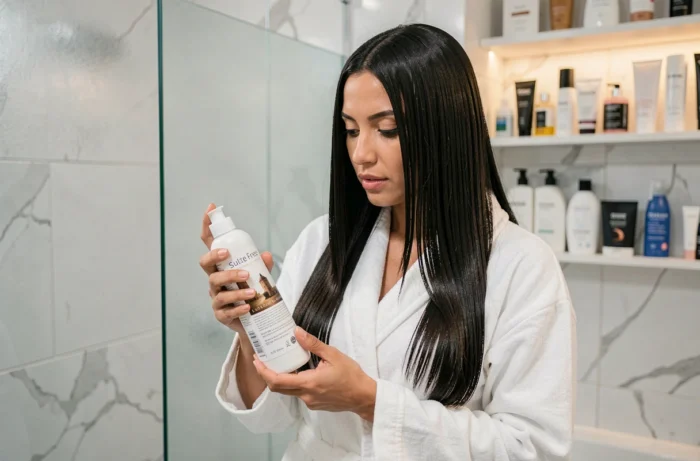
The keratin deposit fixed by the heat of the iron forms a sheath around the hair fiber. Each wash puts this sheath to the test. The choice of shampoo after a Brazilian smoothing directly determines the longevity of the treatment and the condition of the cuticle in the months that follow.
Shampoo pH and keratin bridge stability
A Brazilian smoothing restructures the fiber by creating new bridges between the protein chains, under the combined action of exogenous keratin and high temperature. These bridges remain stable in a slightly acidic environment. A shampoo whose pH exceeds 5.5 raises the cuticle scales and accelerates the loss of the deposit.
We recommend checking the pH indicated by the manufacturer or, if not available, opting for formulas labeled “pH balanced” or “acidic pH.” Shampoos intended for permanent coloring often have a pH between 4.5 and 5.5, which is also suitable for Brazilian smoothing.
To identify the best shampoo after Brazilian smoothing, pH remains a more reliable criterion than the mere mention “sulfate-free,” as a mild surfactant in an alkaline base can cause as much damage as a conventional sulfate.
Sulfates, sodium chloride, and mild surfactants: reading the INCI list
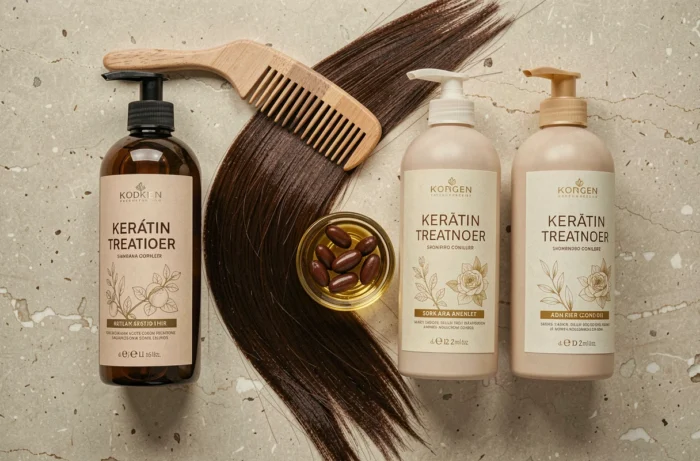
Sulfates like sodium lauryl sulfate (SLS) or sodium laureth sulfate (SLES) are very effective anionic surfactants for degreasing, but their detergent power dislodges the keratin deposited on the fiber. The rule is well known: a sulfate-free shampoo preserves the smoothing for several weeks longer than a conventional shampoo.
Sodium chloride (salt) poses a distinct problem. Added to thicken the shampoo’s texture, it gradually dissolves the keratin film. These two families of ingredients often appear together in mass-market formulas.
Surfactants compatible with Brazilian smoothing
Not all mild surfactants are equal. Here are those we most often observe in suitable formulations:
- Cocobetaine and cocamidopropyl betaine: amphoteric surfactants with low stripping power, they cleanse the scalp without attacking the keratin sheath.
- Sodium cocoyl isethionate: derived from coconut fatty acid, it produces a fine foam and respects the structure of the smoothed hair.
- Decyl glucoside: non-ionic surfactant, very mild, often used in baby ranges and compatible with treated fibers.
A useful reflex: if the foam is abundant and thick from the first application, the shampoo probably contains a surfactant that is too aggressive. A light foam on the first pass is a good indicator of gentleness.
European regulation on formaldehyde and associated shampoos
Brazilian smoothing treatments have long been associated with formaldehyde, a powerful but toxic fixing agent. The European Union has banned formaldehyde as an ingredient in cosmetics since 2019. In 2022, Regulation (EU) 2022/1181 lowered the threshold triggering the obligation to mention “releases formaldehyde”: the ceiling has dropped from 0.05% to 0.001% of formaldehyde released in the finished product.
Stocks not compliant with this new limit can no longer be sold in the European Union after July 31, 2026. This tightening also concerns shampoos containing formaldehyde-releasing preservatives (DMDM hydantoin, imidazolidinyl urea, diazolidinyl urea).
In practice, this means that a post-smoothing shampoo purchased in the EU after this date should no longer contain these preservatives beyond trace amounts. However, we recommend checking the INCI list, as some products imported from outside the EU may escape this framework.
Post-smoothing hair routine: frequency and technical gestures
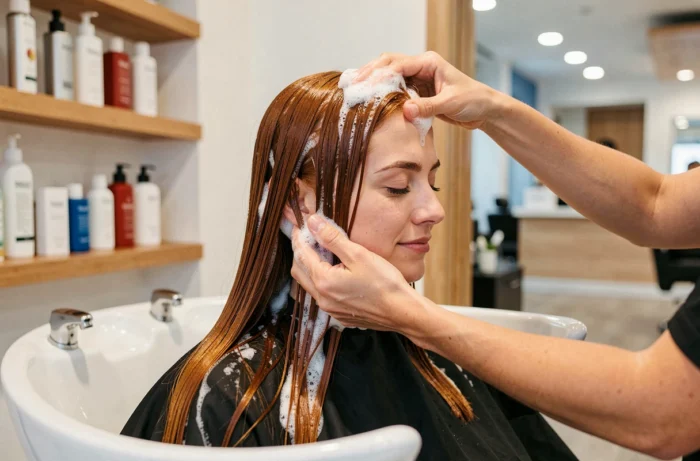
The first shampoo after the application of Brazilian smoothing should only occur after a minimum delay to allow the keratin to fully fix onto the fiber. Most professional protocols prescribe waiting at least 48 to 72 hours.
Beyond this delay, the frequency of washing determines the duration of the result. Two to three washes per week are sufficient for a healthy scalp without compromising the treatment. Each time under water, even without shampoo, partially raises the cuticle.
Water temperature and drying
Hot water opens the scales and promotes the dissolution of the keratin deposit. A rinse with lukewarm water, finished with a jet of cool water, closes the cuticle and prolongs the smoothing. Air drying is less aggressive than blow-drying at high temperatures, but a gentle blow-dry at moderate heat (below 180 °C) is not a problem if a heat protector is applied.
Mask and conditioner: what is compatible
- Hydrolyzed keratin masks: they reinforce the existing deposit and fill in the micro-cracks of the cuticle.
- Conditioners without heavy silicones (dimethicone, amodimethicone in high concentration): light silicones protect the fiber, but heavy silicones create a film that accumulates and eventually weighs down the hair.
- Vegetable oils in leave-in treatments (argan, jojoba): they seal in moisture without interfering with the keratin sheath, applied to ends and lengths.
Brazilian smoothing generally lasts from three to five months depending on maintenance. A poorly chosen shampoo can reduce this duration by several weeks. The issue is not just cosmetic: each smoothing cycle stresses the fiber, and spacing out touch-ups with an adapted routine limits long-term hair fatigue.