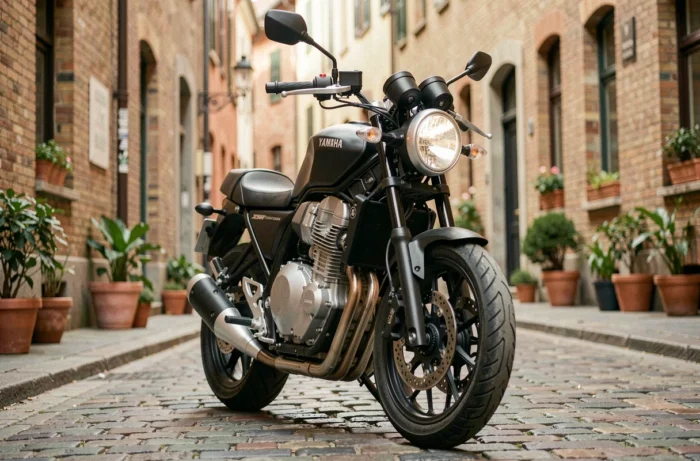
The Yamaha XSR 155 shares its technical base with the XSR125, but the jump to 155 cm³ significantly alters the motorcycle’s profile. Announced power, weight, highway access in Japan, standard ABS on the recent version: these differences are worth measuring before choosing between the two displacements or comparing the XSR 155 to other neo-retro models in the segment.
XSR 155 vs. XSR 125: the differences that matter
The XSR 155 adopts the chassis and ergonomics of the XSR 125, but the engine gains in displacement and power. The table below summarizes the available data.
| Criterion | XSR 125 | XSR 155 |
|---|---|---|
| Displacement | 125 cm³ | 155 cm³ |
| Power | Not specified in this context | 19 PS (around 10,000 rpm) |
| Weight | Not specified in this context | 137 kg |
| Standard ABS | Yes (depending on market) | Yes (ABS version confirmed) |
| Highway access (Japan) | No | Yes |
The power difference allows the XSR 155 to maintain a cruising speed of 100 km/h without straining the engine. This is the tipping point: the 125 remains limited to secondary roads and urban areas in countries where regulations impose it, while the 155 opens access to fast lanes.
To delve deeper into each technical aspect, a comprehensive guide on the Yamaha XSR 155 details the engine, braking, and chassis dimensions.
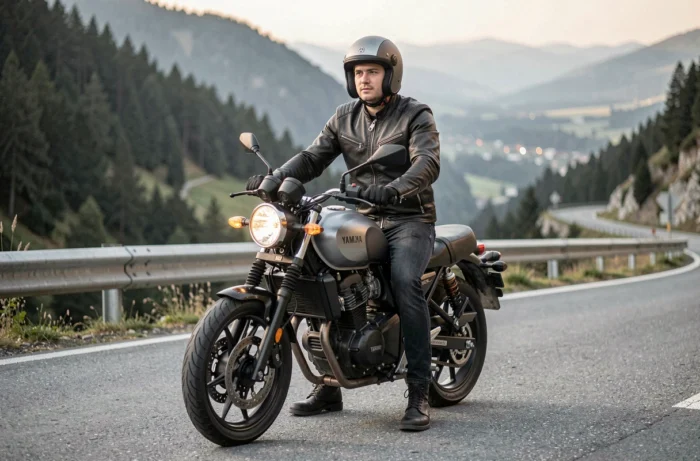
155 cm³ Engine and Road Behavior of the XSR 155
The engine of the XSR 155 inherits the MT-15 platform, a liquid-cooled single-cylinder block. The power of 19 PS remains modest in absolute terms, but relative to the 137 kg of the motorcycle, it provides a favorable power-to-weight ratio for mixed city-highway use.
Japanese tests highlight maneuverability close to that of a 50 cm³ in urban settings, combined with sufficient stability for short highway trips. This dual character is the main argument for the model: lightness does not come at the expense of high-speed stability.
Braking and Safety on the XSR 155
Front and rear disc brakes equip the motorcycle as standard. ABS, which was optional for some Asian markets for a long time, is now integrated as standard on the Japanese version. This point deserves attention at purchase: depending on the country of import, the presence of ABS is not guaranteed on earlier generations.
- Check for the mention “ABS” on the exact model designation before placing any order
- Ensure that the ABS warning light on the dashboard lights up and then turns off at startup, indicating a functional system
- For an imported used model, request the certificate of conformity to confirm the equipped version
Yamaha XSR Neo-Retro Design: Beyond Style
The XSR range (900 launched in 2016, 700 in 2017, 125 in 2023, then 155) is based on a constant principle: retro styling inspired by the 70s-80s laid over modern mechanics. The XSR 155 applies the same recipe with specific colors, including a livery reminiscent of the RZ250.
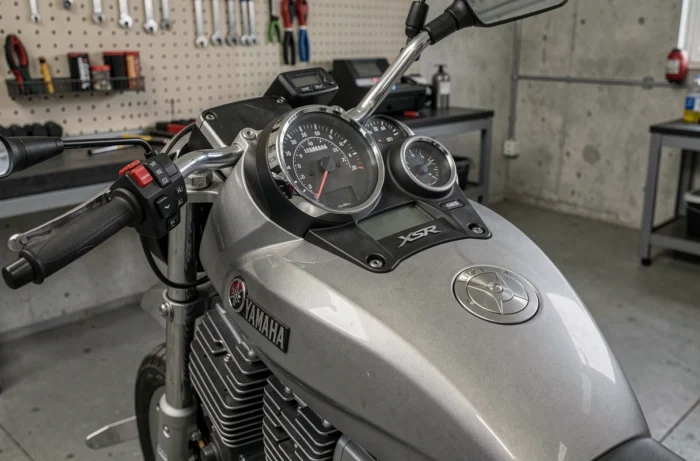
The aesthetic choice is not neutral regarding practicality. The round seat, typical of the café racer style, limits comfort on long journeys. The rear-set controls alter the riding position compared to a standard MT-15. These compromises are acceptable in the city and on outings of a few dozen kilometers, but less so on extended highway routes.
Colors and Limited Editions
Yamaha regularly offers special series on the XSR 155. The “RZ250” livery features the white, red, and blue colors of the historic model. These limited editions retain the same technical specifications as the standard model, but their resale value tends to hold better in the used market.
Accessories and Customization of the Yamaha XSR 155
Customization is part of the DNA of neo-retro. On the XSR 155, several areas deserve special attention.
- Tires: switching to higher-performance tires improves grip in corners without altering the geometry, provided the original dimensions are respected
- Seat: an aftermarket thicker or shaped seat corrects the main comfort flaw of the model
- Engine protection: a skid plate and protective pads preserve the mechanics in case of a low-speed fall, common during learning
- Exhaust: replacing the original exhaust system alters the sound and can free up a few tenths of a horsepower, but be mindful of sound compliance according to local regulations
The range of compatible accessories is gradually expanding, driven by the MT-15/XSR community that shares the same technical base. The majority of MT-15 parts fit directly onto the XSR 155, which multiplies options without relying solely on the Yamaha catalog.
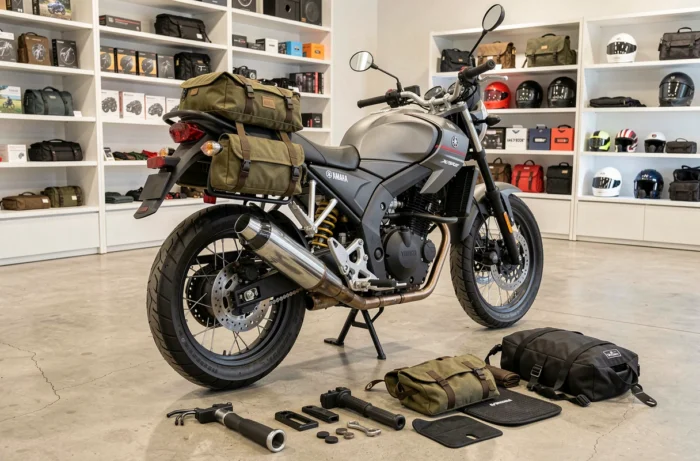
The Yamaha XSR 155 occupies a specific niche: powerful enough to exceed the limits of the 125 category, light enough to remain accessible to beginners, and featuring a style that distinguishes it from generic roadsters. The determining criteria remain availability in your market and the confirmed presence of ABS, two points to check before making any purchasing decision.