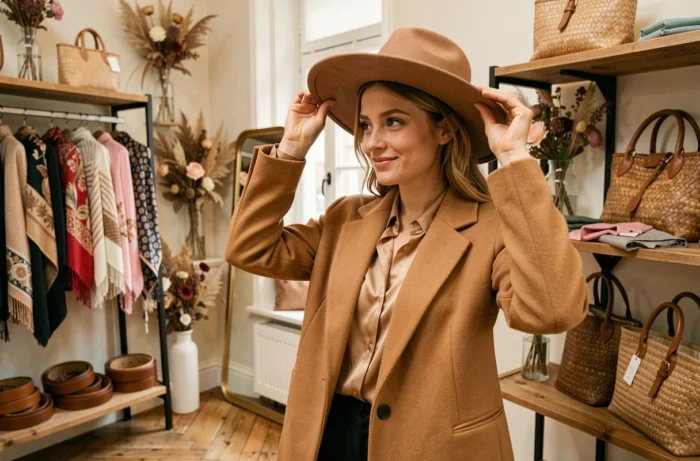
An accessory changes the perception of an outfit faster than a change of clothing. Bag, belt, jewelry, or scarf: each piece acts as a focal point that directs the gaze and structures the silhouette. This season, trendy accessories stand out for their dual role, aesthetic and functional, with omnipresent natural materials and a new focus on the resale value of chosen pieces.
Accessories and resale value: a central purchasing criterion
Style guides generally present accessories from the perspective of looks. They overlook a factor that is increasingly weighing in the purchasing decision: the estimated resale value at the time of purchase.
According to data published by The RealReal in its 2026 report, nearly 47% of consumers consider the future resale value of a bag or piece of jewelry before checking out. Accessories are no longer just style touches; they function as quasi-financial assets for a significant portion of buyers.
This phenomenon particularly affects structured leather bags and designer jewelry. A branded bag whose value remains stable in the secondary market becomes a rational choice compared to a trendier model with no resale potential. To enhance your outfits without sacrificing the durability of your investment, exploring By Julie’s accessories allows you to find pieces that combine bold style and longevity.
Generation Z and millennial buyers amplify this trend. According to The RealReal, a major share of young luxury buyers consults the second-hand market before purchasing a new accessory, systematically comparing retail prices and resale values.
Structured bags and soft bags: two silhouettes for two uses
The bag remains the accessory that most visibly transforms an outfit. This season, two families share the spotlight.
The rigid bag with geometric lines
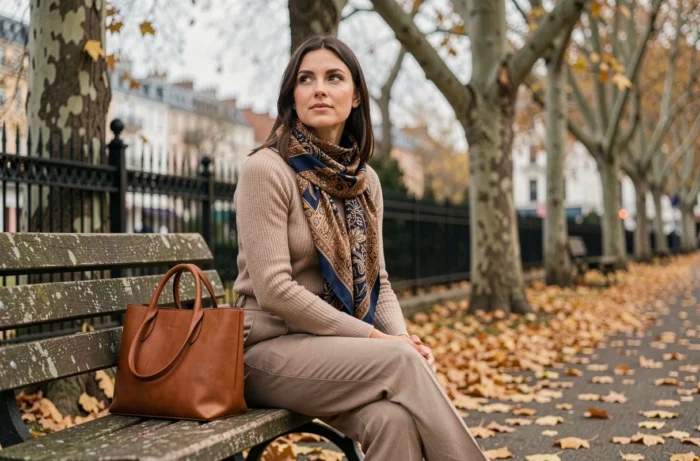
Structured models, often made of grained leather or recycled materials, bring a sharp look to a flowing dress or a casual ensemble. Their compact format (short shoulder strap, metal clasp) directs the gaze towards the waist and structures the silhouette without a belt.
The soft tote in natural material
Raffia, woven linen, crocheted cotton: large soft bags remain a safe bet for extended summer outfits into early autumn. Their main advantage is versatility. A raffia tote transitions from the office to a terrace dinner without a hitch.
The choice between these two families depends less on trend than on daily use. A rigid bag suits silhouettes that one wants to refine, while a soft bag is ideal for days when carrying volume is a priority.
Layered jewelry: the proportion rules to know
Layering jewelry (necklaces, bracelets, rings) is a powerful personalization lever, provided that a few proportion principles are respected. Without method, accumulation creates a messy effect that overwhelms the outfit instead of enhancing it.
- Vary thicknesses: pairing a fine chain with a more substantial necklace creates a readable contrast. Two pieces of the same thickness visually neutralize each other.
- Limit metals to a maximum of two tones per outfit: gold and silver can coexist, but adding copper or bronze disrupts harmony with most clothing colors.
- Respect the rule of a single focal point: if the earrings are large, the necklace should remain discreet, and vice versa. The gaze should have one place to rest.
Gold metal jewelry dominates this season’s collections, worn on both monochrome outfits and prints. Wide rings and thick hoops are the most spotted pieces on the runways for autumn-winter 2026.
Belt and scarf: two accessories that modify the cut of a garment
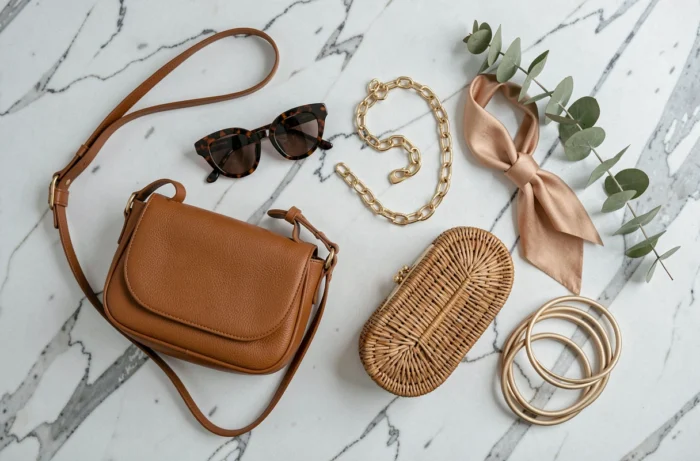
Unlike bags or jewelry, the belt and scarf directly affect the perceived shape of the worn garment. They are transformation accessories, not just decorative ones.
The belt as a cutting tool
Worn over an oversized blazer or a straight dress, a medium-width belt (3 to 5 cm) creates an artificial cinching point. It reshapes the waist without alteration. Braided leather models or those with a round buckle offer a softer touch than rectangular buckle belts, which are often associated with a more formal style.
The scarf as a décolleté modifier
Tied around the neck, a lightweight scarf alters the neckline of a top or shirt. Worn as a headband, it restructures the upper part of the silhouette. One scarf can produce three distinct looks depending on its placement: neck, wrist, or bag handle.
Bright colors (saffron yellow, terracotta, lavender blue) dominate this season’s palette. A colorful scarf on a neutral outfit is enough to visually anchor the whole in current trends, without multiplying pieces.
Choosing accessories according to the outfit’s style
A common mistake is to accumulate trendy accessories without checking their coherence with the main garment’s style. A simple table helps clarify the associations:
| Outfit Style | Suitable Accessories | Accessories to Avoid |
|---|---|---|
| Casual (jeans, t-shirt) | Soft tote, layered fine jewelry, braided belt | Glossy rigid bag, statement jewelry alone |
| Dressed up (dress, suit) | Structured bag, large earrings, silk scarf | Raffia tote, accumulation of bracelets |
| Mixed (blazer + jeans) | Defined belt, crossbody bag, one wide ring | Too many layers, hat + scarf + jewelry |
This principle of coherence avoids the trap of the “total trendy look” where each accessory draws attention without any actually serving the outfit.
This season’s accessories reward measured choices. Two or three well-calibrated pieces, chosen for their style potential as well as their durability, transform an existing wardrobe more effectively than a complete renewal of clothing.