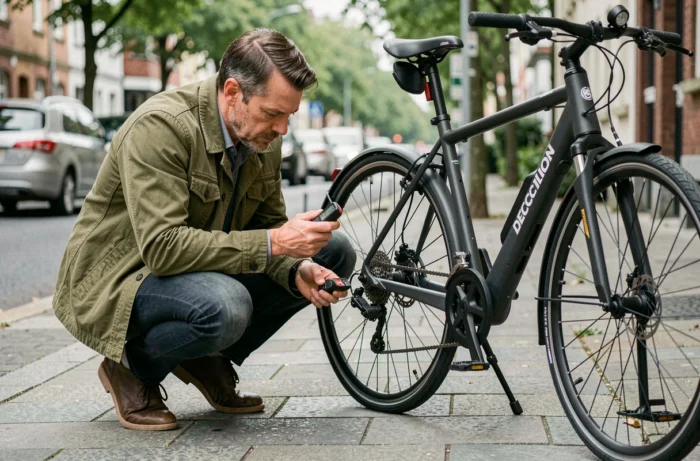
A Decathlon electric bike that refuses to turn on or whose assistance cuts out unexpectedly is almost always due to a fault that can be identified without specialized tools. Most breakdowns affect three areas: the battery, the motor, and the display. Before going to a workshop, a methodical diagnosis often helps locate the source of the problem and, in some cases, resolve it yourself.
Frame warranty and electrical warranty: two distinct regimes at Decathlon
Decathlon applies a so-called “lifetime” warranty on the frame of its bikes, including electric assistance models from the Rockrider, Riverside, or Elops ranges. This warranty covers structural manufacturing defects, such as a crack at a weld.
On the other hand, the electrical components (battery, motor, console, wiring) are subject to a standard warranty limited to two years. After this period, any breakdown of these components results in a workshop quote or requires replacement at the owner’s expense.
This distinction changes the diagnostic strategy. A cracked frame detected several years after purchase may still be covered for free. A failing battery after three years does not benefit from the same coverage. Accurately identifying Decathlon electric bike problems at the first symptoms prevents letting a fault covered by the warranty linger until it expires.
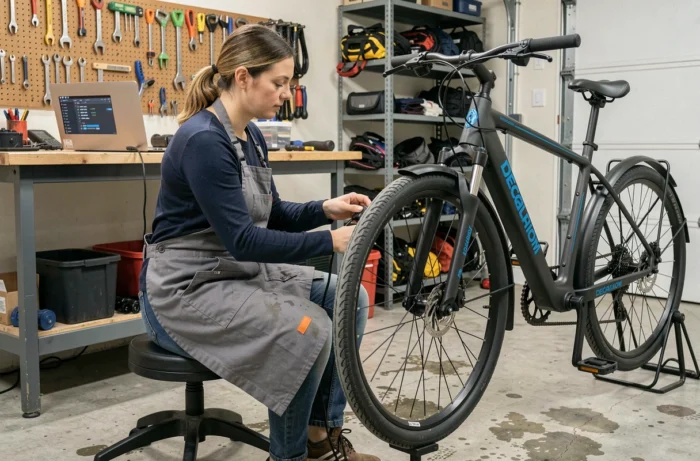
Battery failure on Decathlon electric bike: step-by-step diagnosis
The battery accounts for the majority of electrical failures reported by users. The first reflex is to check the condition of the charger itself: a light that never turns green, or that remains off when the battery is plugged in, often indicates a faulty charger rather than a dead battery.
Check the physical connection
Remove the battery from its housing, inspect the metal contacts on the bike and on the battery. Dust, moisture, or slight oxidation on these connectors is enough to cut the circuit. Cleaning with a dry cloth and a gentle rub on the terminals restores contact in many cases.
Test the charge on another outlet
Plug the charger into a different wall outlet, without a power strip or extension cord. Some Decathlon chargers are sensitive to voltage fluctuations and do not start charging if the power supply is unstable. If the battery accepts the charge on another outlet, the problem lies with the home electrical circuit, not the bike.
Battery life in free fall
A battery that loses half of its range in a few months indicates accelerated aging of the cells. Storing the battery fully discharged or exposed to extreme temperatures accelerates this phenomenon. To prolong its lifespan, keep the battery charged between one-third and two-thirds of its capacity, in a temperate place.
Motor and pedaling sensor: when assistance cuts out while riding
An intermittent cut in assistance while pedaling rarely points to the motor itself. The component most often at fault is the pedaling sensor, a magnetic disc mounted near the crankset that detects the rotation of the cranks.
- If the assistance works in fits and starts, check that the magnet of the sensor is properly aligned with the receiver mounted on the frame. A gap of a few millimeters is enough to disrupt the signal.
- Inspect the cable connecting the sensor to the controller: a pinched, bent, or trapped wire in the cable passage intermittently cuts the signal, especially in turns or on rough terrain.
- On Rockrider and Riverside models, the torque sensor (which measures the pressure applied to the pedals) can become misaligned after a shock to the crankset. A visit to a Decathlon workshop with the dedicated diagnostic tool allows for recalibrating the sensor.
A motor that emits a continuous grinding noise or that feels unusually hot to the touch after a few minutes of use requires workshop intervention. These symptoms go beyond the scope of a home diagnosis.
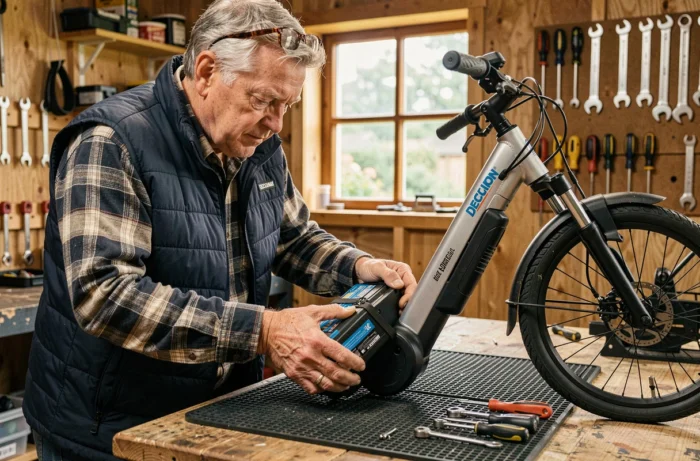
Screen and error codes: reading what the system displays
The consoles mounted on Decathlon e-bikes (depending on the ranges) display numbered error codes when a component malfunctions. A screen that does not turn on at all despite a charged battery indicates a connectivity issue between the console and the main harness.
Unplug and then replug the connector located at the back of the screen. On some models, this connector can be unclipped by gently pulling. A poor connection at this point causes a black screen or a frozen display.
When an error code appears, note it down before any manipulation. Each code corresponds to a specific component (motor, battery, sensor). The manual provided with the bike lists the correspondence between codes and the relevant components. Communicating this code to the Decathlon workshop speeds up the diagnosis and avoids billing for search time.
Repairability of Decathlon bikes: four criteria to know
Decathlon has set internal criteria to evaluate the repairability of its products. According to Les Numériques, the brand validates that a product is repairable if four conditions are met: free documentation, availability of spare parts, product disassemblable, and repair cost lower than a significant fraction of the new price.
In practice, this means that wear parts (brake pads, tires, derailleur cables) remain accessible in-store or online for most recent models. Electrical components (replacement battery, console, sensor) are also available, but their price may make repair less appealing on an older model.
Before ordering a part, check the exact reference on the bike’s product sheet (accessible via the Decathlon website with the serial number). A battery with the wrong reference will not be recognized by the controller and the system will refuse to start, even if the physical format seems identical.
The diagnosis of a Decathlon electric bike follows a simple logic: battery and connectivity first, pedaling sensor next, console and error codes last. This hierarchy reflects the actual frequency of failures and allows most problems to be resolved without specialized tools or a workshop visit.