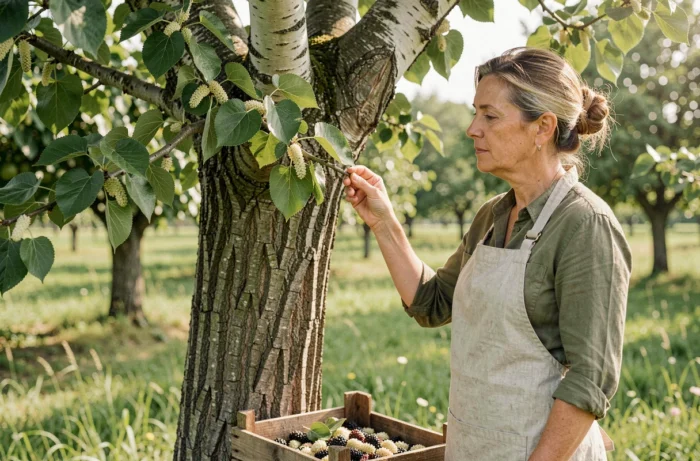
The plane tree mulberry most often refers to a white mulberry (Morus alba) pruned into a parasol shape, not a distinct botanical species. This distinction changes everything for those looking to harvest edible fruits: the umbrella training, designed to increase shade, can significantly reduce fruiting. Choosing the right tree means understanding what the term “plane tree mulberry” actually encompasses and identifying the varieties that produce blackberries in harvestable quantities.
The most common trap occurs right at the garden center. Advisors almost systematically recommend the variety Morus platanifolia ‘Fruitless’, a sterile plane tree mulberry that produces no fruit at all. This recommendation aims to avoid stains on patios and furniture, but it completely excludes any harvest. When considering the plane tree mulberry and edible fruits, the first question to ask the seller concerns the fertility of the proposed variety.
Morus alba, Morus nigra, Morus rubra: which species for edible fruits
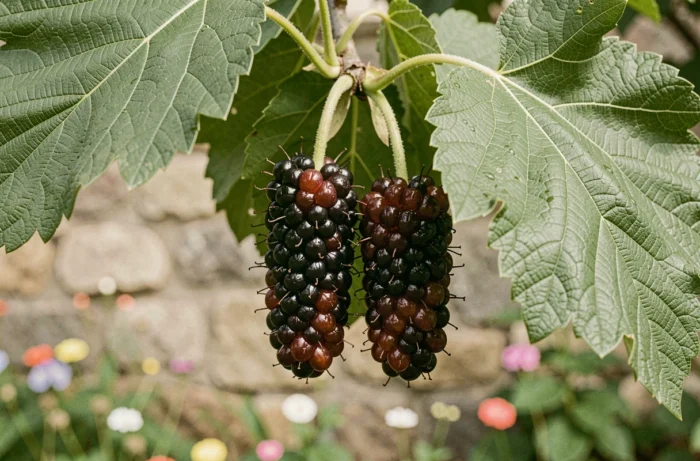
The color of the fruit does not help identify the species. A Morus alba, despite its name of white mulberry, can produce white, pink, red, or nearly black fruits. A Morus rubra does not retain its red fruits at maturity: they often turn dark purple.
For a harvest-oriented project, three species deserve attention:
- Morus nigra (black mulberry): produces the most flavorful blackberries, with juicy and tangy flesh. Its growth is slower and its hardiness slightly lower than that of the white mulberry, but the taste quality more than compensates.
- Morus alba (white mulberry): a highly variable species, some fruiting varieties yield abundant harvests. The flavor ranges from sweet to bland depending on the cultivar. This is the species most often sold under the name “plane tree mulberry.”
- The hybrids Morus alba x Morus rubra: they combine the vigor of the white mulberry with more aromatic fruits. Their earliness makes them interesting in regions with short summers.
In summary, if fruit flavor is paramount, a non-pruned Morus nigra will yield better results than a white mulberry pruned into a plateau. The “plane tree” shape remains primarily an aesthetic and functional choice related to shading.
Fruiting or sterile varieties: criteria to check before purchase
The distinction between fertile and sterile varieties is the tipping point of the project. A sterile plane tree mulberry (‘Fruitless’) perfectly fulfills its role as a shade tree, with dense foliage and a parasol shape. However, it will never produce edible blackberries, regardless of the size or care given.
For an effective harvest, several criteria must be examined at the time of purchase:
- The explicit mention “fruiting” or “fertile” on the label. The absence of mention guarantees nothing: ask for written confirmation from the nursery.
- The earliness of fruiting. Some cultivars of Morus alba only ripen properly in areas with long, warm summers. In northern France, an early hybrid will avoid harvesting green fruits at the end of the season.
- Sensitivity to late frosts. The young shoots of some mulberries can be damaged by spring frosts, compromising that year’s fruiting.
- The ability of the wood to finish its growth before winter. A mulberry whose branches are not hardened by autumn will suffer frost damage and produce less the following year.
Buying from a specialized nursery rather than a general garden center increases the chances of finding an identified cultivar suited to its climatic zone.
Parasol training and fruiting: a compromise to negotiate
Plateau pruning, which gives the mulberry its characteristic parasol silhouette, directly affects fruit production. A white mulberry severely pruned each year produces fewer blackberries than one grown freely. The reason is simple: fruits form on the wood from the previous year. Removing a large part of the branches means eliminating future fruiting sites.
To reconcile shade and harvest, moderate pruning in autumn or late winter works better than severe annual cutting. Keeping the main scaffold branches and only shortening the most vigorous lateral branches helps maintain a spread shape while preserving enough fruiting wood.
The case of Morus nigra grown freely
The black mulberry does not lend itself well to strict parasol pruning. Its natural shape is more rounded, less spread out than that of the white mulberry. Forcing it into a plateau requires repeated interventions that weaken the tree and reduce production. For a black mulberry, the free or goblet shape remains the best fruiting option.
If the main goal is to harvest flavorful blackberries with secondary shading, it is better to plant a Morus nigra in a free shape near a terrace, even if it means accepting less dense shade than that of a classic plane tree mulberry.
Soil, exposure, and location: conditions for good mulberry fruiting
Mulberries tolerate various soils, but fruiting depends on generous sunlight. A location receiving full sun for most of the day promotes fruit ripening and concentrates sugars in the flesh.
The soil must be well-draining. A mulberry planted in heavy, waterlogged soil in winter develops a fragile root system and produces more watery, less flavorful fruits. Adding compost at planting improves soil structure without excess nitrogen, which would stimulate foliage at the expense of fruiting.
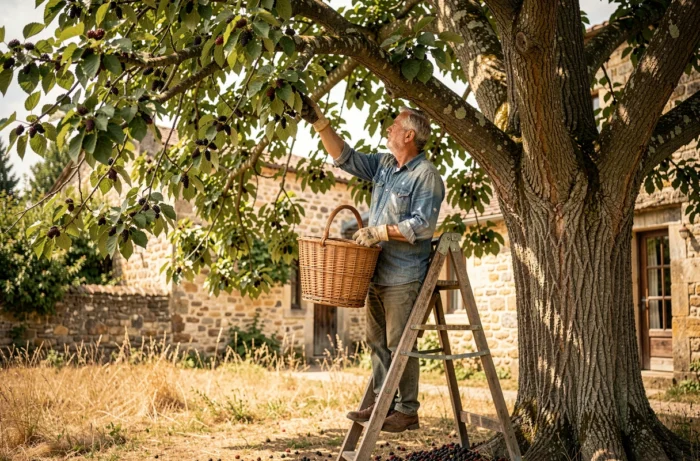
The proximity of a terrace or passage area poses a concrete problem: ripe blackberries fall to the ground and permanently stain tiles, furniture, and clothing. Purple stains are very difficult to clean. Planting the fruiting mulberry a few meters away from any sensitive surface avoids this inconvenience without sacrificing shade.
The choice between a sterile plane tree mulberry for shade and a fruiting mulberry for harvest is rarely compatible in the same tree. Clearly identifying one’s priority before purchase, checking the cultivar name on the label, and adapting the pruning approach to the chosen goal are the three decisions that determine the success of the project, well before questions of soil or watering.