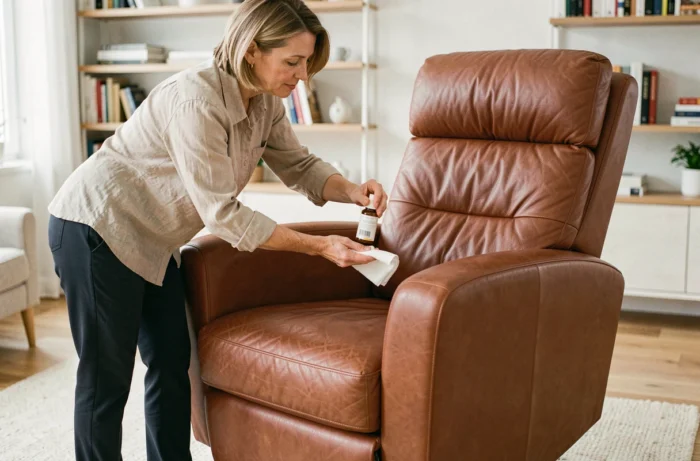
A Stressless leather armchair starts to show signs of wear long before the mechanism fails. This is first noticeable on the armrests: the leather dries out, the pores become marked, and the color fades. In most cases, the problem does not stem from natural wear, but from a lack of maintenance or improper care for the type of leather involved.
Identify the type of leather before any handling
You do not clean pigmented leather like aniline leather. On Stressless armchairs, several finishes coexist in the catalog: protected leather (the most common), semi-aniline, and pure aniline (Noblesse range, for example). Tolerance to moisture, sensitivity to solvents, and maintenance frequency vary from one type to another.
Pigmented leather can withstand regular damp wiping. Aniline leather, which is much more porous, absorbs liquids quickly and marks with the slightest prolonged contact with water. Applying an unsuitable product on aniline leather can irreversibly stiffen the surface.
To check, place a drop of water on a hidden area (under the seat or behind the headrest). If the water absorbs within a few seconds and darkens the leather, you are dealing with aniline or semi-aniline. If it beads on the surface, the leather is protected. This test takes ten seconds and avoids costly mistakes.
Detailed guides on caring for a Stressless leather armchair remind of this step, but it is rarely applied in practice. The majority of users clean their armchair with the first product found under the sink.
Panel cleaning: the method that preserves the uniformity of the leather
The classic reflex is to spray a cleaner over the entire armchair and then scrub. This is exactly what should not be done. Field reports show that this approach creates differences in shade between areas that have been scrubbed for a long time and those that have been lightly touched.
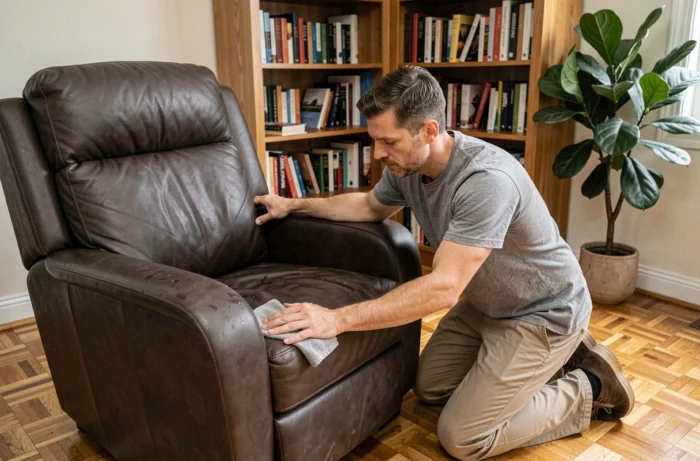
Clean one area at a time, never the entire armchair at once. Start with one armrest, finish with the other, going through the seat and then the backrest. Each panel is cleaned, wiped, and dried before moving on to the next.
The right gesture with the cloth
The cleaning product should be applied to the cloth, not directly on the leather. A slightly damp white cotton cloth remains the reference. Colored microfibers can bleed onto light leathers.
- Apply the cleaner to the white cloth, not on the leather, to control the amount deposited
- Work in circular motions on an area the size of an A4 sheet
- Wipe immediately with a second dry cloth before moving on to the next area
- Perform a preliminary test on a hidden part of the armchair (under the cushion, back of the headrest)
This method takes a bit more time than a general cleaning, but it guarantees a uniform result, without streaks or variations in shine.
Frequency and products: what Stressless actually recommends
The brand recommends a complete cleaning followed by the application of protective cream at least every six months. Between two complete cleanings, a weekly wipe with a soft, slightly damp cloth is sufficient to remove dust and sweat residues.
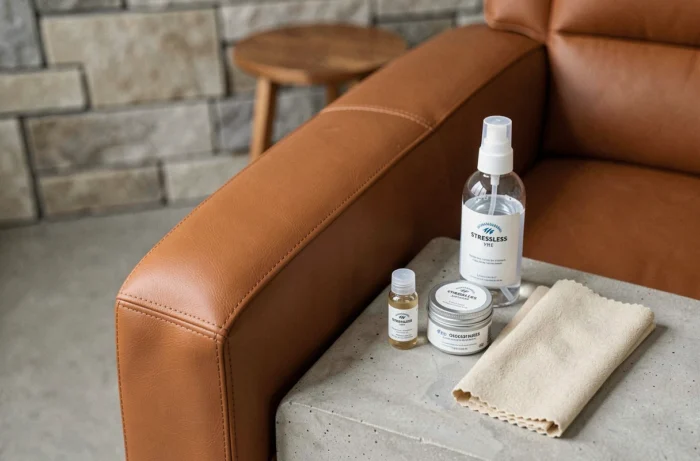
The official Stressless maintenance kit contains a leather cleaner and a protective cream. Maintenance wipes are also available for quick touch-ups. On aniline leathers, the protective cream should be applied as soon as the armchair is received, even before the first use.
Products to avoid
Stressless strongly discourages products containing solvents or oils. Diluted Marseille soap, often cited in public tips, poses no problem on pigmented leather, but feedback varies on semi-aniline leathers where it can leave a film. Makeup remover, another classic, works in emergencies on a fresh stain, provided it is rinsed quickly.
- Solvents (acetone, white spirit, 90% alcohol): risk of discoloration and drying
- Vegetable or mineral oils: they clog the pores and prevent the leather from breathing
- Scented household wipes: the chemical agents attack the finish layer
Water stains on Stressless leather: the rubbing trap
A water ring on a leather armchair often triggers vigorous rubbing. This is the worst reflex. Rubbing moves the surface pigments and deepens the mark instead of diminishing it.
The correct technique is to uniformly dampen the entire area around the stain. Take a very slightly damp cloth, apply it to a surface larger than the ring, and let it dry naturally, away from any heat source. The water evaporates evenly, and the mark disappears without mechanical intervention.
This principle of uniform moisture application also applies to rain stains or accidental splashes. The sooner you intervene, the less the mark persists.
Protect leather from heat and sunlight daily
Stressless leather, like all natural leather, fades with prolonged exposure to sunlight. The Noblesse range, made from very lightly treated aniline leather, is particularly vulnerable.
Stressless recommends maintaining a space of at least 30 cm between the armchair and any heat source (radiator, fireplace, south-facing bay window). In summer, a simple filtering curtain significantly reduces UV exposure without condemning the room to darkness.
Pet claws represent another common source of damage. Pigmented leather is more resistant to micro-scratches, but no treatment protects against repeated cat claws. If a pet has access to the armchair, a removable cover on the most exposed areas remains the only realistic solution.
A well-maintained Stressless armchair retains its comfort and appearance for many years. The difference between leather that ages well and leather that deteriorates rarely lies in the budget spent on products: it lies in the consistency of care and respect for the type of leather.