
The regulatory tightening around fossil fuels is redefining the technical choices regarding the selection of a heat generator. Between the removal of reduced VAT rates on gas boilers and the evolution of MaPrimeRénov’, the sizing of an installation is no longer just a power calculation: it is an exercise in fiscal and normative compliance.
VAT on gas boilers: fiscal impact on the actual installation cost
The 2025 finance law has profoundly altered the economic equation of gas in renovation. Since January 1, 2025, the VAT on the supply and installation of a gas boiler has increased from 5.5% to 10%. By March 1, 2025, it will reach the normal rate of 20% for any replacement in existing housing.
This fiscal shift represents a direct additional cost of several hundred euros on a typical quote. For a household hesitating between keeping a condensing gas boiler and switching to an air/water heat pump, the price gap at purchase is mechanically narrowing. We observe that this pricing signal is already steering quote requests towards decarbonized solutions.
When sizing a project, it is essential to integrate taxation from the estimation phase. Comparing solely based on the catalog price leads to distorted choices, as Aireo Chauffage heating equipment clearly illustrates the diversity of available ranges in heat pumps, pellets, or hybrid systems, each subject to a different VAT regime.
MaPrimeRénov’ and extensive renovation: gas systems now excluded
Since September 1, 2026, keeping a gas boiler after extensive renovation (work combining insulation, heating, and ventilation in a single-family home) makes the project ineligible for MaPrimeRénov’ Extensive Renovation. The constraint is binary: either the heat production system is completely decarbonized, or the application is rejected.
This rule does not concern the simple one-off replacement of an appliance. It targets comprehensive renovations where the thermal envelope of the building is treated simultaneously with the generator. In practice, a homeowner who insulates their attic, changes their windows, and installs a double-flow VMC must also abandon gas to receive the aid.
The systems that remain eligible in this context are the heat pump (air/water or geothermal), connection to a district heating network, and the wood pellet boiler. Gas, even condensing, is excluded from the most ambitious aided renovation pathways.
Air/water heat pump: often overlooked sizing criteria
The air/water heat pump accounts for the majority of installations replacing fossil boilers. We recommend checking three technical parameters before validating a quote, which public comparisons rarely review.
- The water supply temperature: a high-temperature heat pump (up to 65 °C output) allows for the retention of existing cast iron radiators, but its COP drops compared to a low-temperature model coupled with underfloor heating
- The bivalence point: this is the outside temperature below which the heat pump no longer meets the needs alone. In a continental climate, an integrated electric backup can represent a significant part of winter consumption if the sizing is too tight
- The F-Gas regulation on refrigerants: the European schedule for reducing hydrofluorocarbon (HFC) quotas is gradually increasing the maintenance costs of heat pumps using high global warming potential fluids, favoring models operating on R-290 (propane) or R-32
Poor sizing generates short cycles (frequent on/off) that wear out the compressor and degrade seasonal efficiency. The nominal power must correspond to the actual thermal loss of the building after insulation work, not before.
Wood and pellet heating: supply constraints and emission standards
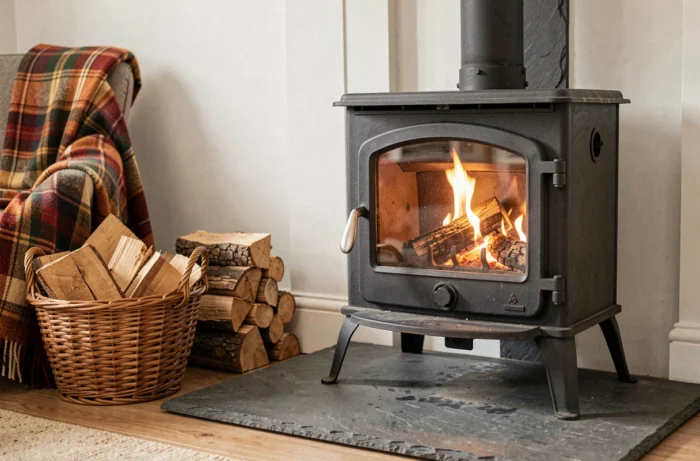
Wood remains the heating energy with the lowest cost per kWh on the French market. A pellet stove or a log wood boiler appeals with its favorable carbon footprint, but two points deserve technical attention.
Emission standards for fine particles are tightening in low emission zones. Some metropolitan areas are already restricting the use of open fireplaces and old appliances not labeled Flamme Verte 7 stars. Before investing, checking local regulations avoids installing a system that may become non-compliant in the medium term.
The supply of pellets has faced tensions in recent years, with marked price fluctuations. For a pellet boiler used primarily, a sufficiently sized storage silo and an annual delivery contract secure availability. Log wood, on the other hand, requires a ventilated storage space and a moisture content below 20% to ensure proper efficiency.
Electric heating: limited relevance to very well-insulated homes
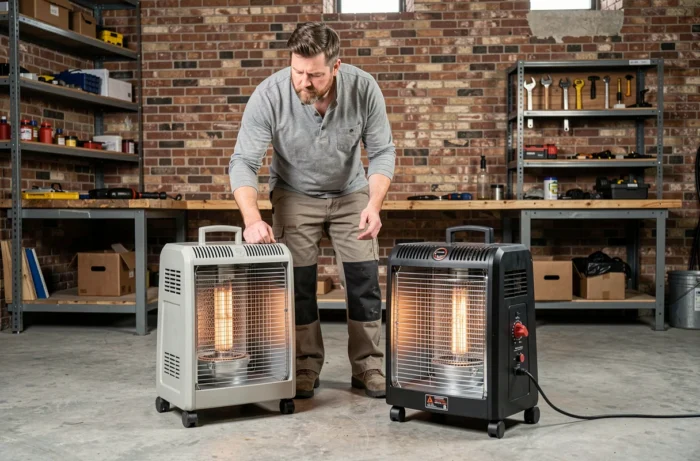
Electric radiators with inertia or radiant panels remain relevant in one specific case: a small housing unit with high-performance insulation (like BBC renovation or RE 2020). In this context, the low thermal loss makes the operating cost acceptable despite a high price for electricity per kWh.
For a poorly insulated house over 100 m², all-electric heating with convectors generates disproportionate bills. We recommend reserving this option for studios, recent apartments, or well-insulated extensions where the required power remains modest.
The choice of heating equipment today depends as much on the fiscal and regulatory framework as on raw thermal performance. A project that ignores the trajectory of MaPrimeRénov’, the taxation on gas, or the F-Gas schedule risks becoming obsolete even before the end of its amortization.