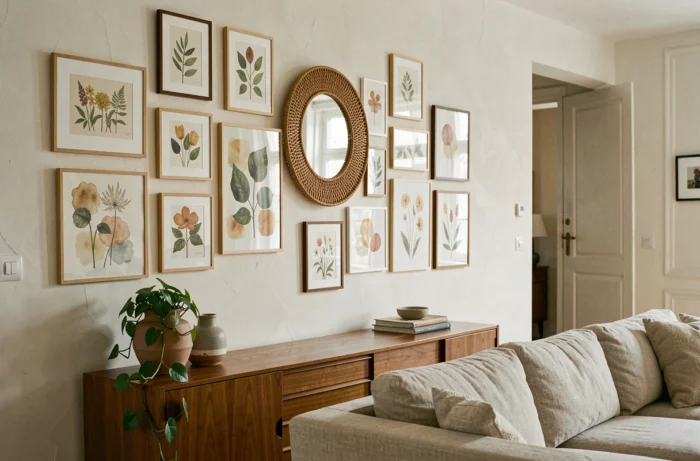
Choosing a wall covering or a wall object is not just a matter of taste. Wall decoration involves measurable criteria: emissions of volatile organic compounds (VOCs), light resistance, size suitable for the proportions of the wall, color palette consistent with the rest of the room. Comparing these parameters before purchasing avoids costly mistakes and returns to the store.
VOCs and labeling: the health criterion that decor guides ignore
In France, every interior decoration product (paint, wallpaper, decorative panel) must display a VOCs emission classification label, from A+ to C. A product rated A+ emits very few pollutants into the ambient air, while a C rating indicates significantly higher emissions.
This criterion concretely modifies the choice of wallpaper or wall panel. Two visually similar references may belong to different classes. Checking this label before purchase protects the air quality in enclosed spaces, particularly bedrooms and offices.
The catalogs available on wallstore.be allow filtering wall coverings according to several technical characteristics, making selection easier without sacrificing style.
- Class A+: lowest emissions, suitable for children’s rooms and poorly ventilated spaces.
- Class A: low emissions, suitable for most living areas.
- Classes B and C: reserved for well-ventilated spaces or covered outdoor surfaces.
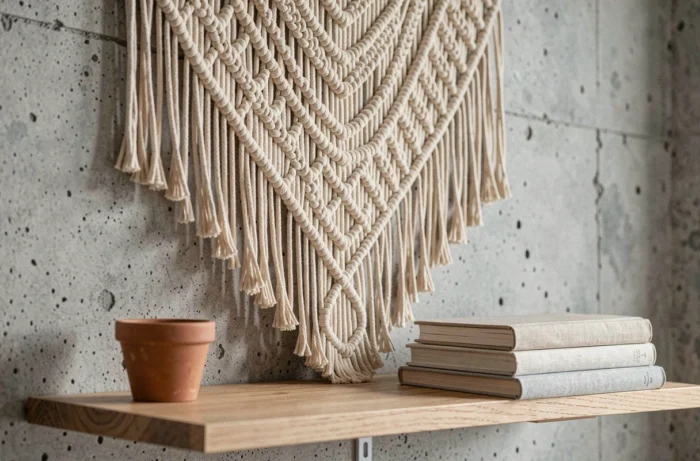
Subtle neutrals vs. uniform beige: color micro-trends 2025-2026
The dominant trend in wall decoration is moving away from flat beige that has saturated interiors in recent years. Current palettes favor more nuanced neutrals like greige, sandy beige, or mushroom. These shades retain the softness of beige while adding a visual depth that standard beige does not produce.
The difference lies in the undertones. Greige blends gray and beige, giving it a more contemporary look under natural light. Mushroom leans towards rosy taupe, warmer under artificial lighting. Sandy beige, on the other hand, remains close to natural sand but with a slightly higher saturation than classic beige.
| Shade | Dominant Undertone | Appearance in Natural Light | Appearance in Artificial Light |
|---|---|---|---|
| Classic Beige | Yellow | Flat, little relief | Slightly yellowish |
| Greige | Gray | Fresh, contemporary | Neutral, stable |
| Sandy Beige | Light Ochre | Bright, natural | Warm without excess |
| Mushroom | Rose-Taupe | Soft, enveloping | Warm, rosy |
Testing a sample on the wall remains the only reliable method. The same shade can shift from gray to pink depending on the window orientation and the type of bulb used in the room.
Panoramic murals and custom wallpaper: a clear rise in power
Panoramic murals are taking an increasingly prominent place in wall decoration projects. Their principle is to cover an entire wall with a continuous image, printed on several strips of wallpaper joined edge to edge. The result creates a unique focal point that replaces paintings, shelves, and decorative objects on the concerned surface.
Custom wallpaper takes this logic further. The mural is produced to the exact dimensions of the wall, eliminating visible seams and rough cuts. This precision comes at a higher cost than standard wallpaper, but it eliminates material waste.
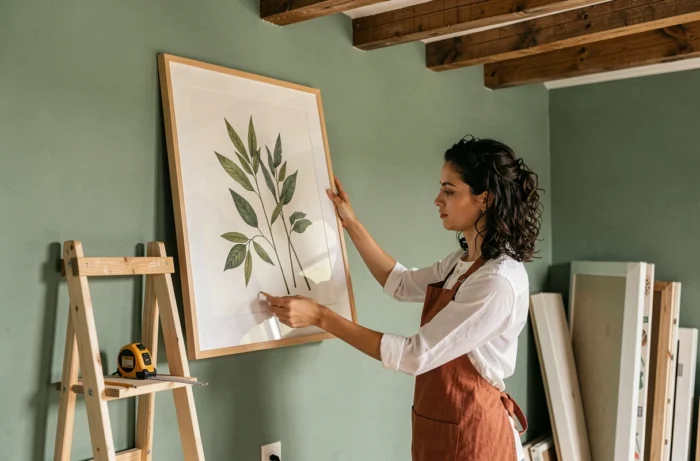
Adapting the pattern to the volume of the room
A perspective mural (distant landscape, open architecture) visually enlarges a small space. In contrast, a dense and contrasting pattern on a small wall can overwhelm the room. The practical rule is: the narrower the wall, the more airy the pattern should remain.
Floral patterns remain dominant in panoramic murals. The trend of “living walls,” which reproduce foliage, forests, or tropical gardens, is part of a broader movement to integrate nature into living spaces.
Wall art and posters: choosing the right format for the wall
Hanging a painting or a poster seems simple. However, the result depends on the relationship between the size of the artwork and the available surface. A frame that is too small on a large wall creates a lost effect. An overly large format in a narrow hallway overwhelms the passage.
- Wall above a sofa: the total width of the composition (a frame or a set) ideally covers between half and two-thirds of the length of the seating.
- Hallway wall: prefer vertical formats or a series aligned in a horizontal frieze to accompany the flow of movement.
- Living room wall without furniture underneath: a large unique format or a triptych occupying a generous surface to avoid the “postage stamp” effect.
- Above a console or shelf: the frame should not exceed the width of the furniture, otherwise the whole appears unbalanced.
Custom paintings and limited edition posters are gaining ground against generic reproductions. Choosing a unique piece enhances the visual identity of an interior, whereas a mass-produced poster remains interchangeable from one living room to another.
Frame materials and stylistic coherence
A natural wood frame fits into Scandinavian or rustic interiors. A black metal frame suits industrial or minimalist atmospheres. The absence of a frame (canvas stretched on a chassis, poster held by clips) corresponds to a more relaxed style.
Mixing frame materials in a gallery wall works as long as a common thread is maintained: same thickness of molding, same color of mat, or the same color palette in the artworks themselves.
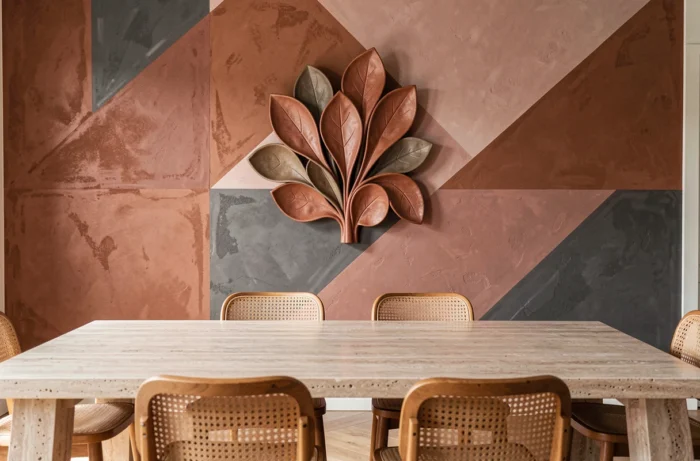
Wall decoration is as measurable as it is felt. VOC label, chromatic undertone, format-surface ratio, print quality of murals: each technical parameter influences the final result long before personal taste comes into play. A successful wall begins with these checks; style comes afterward.