Transporting fresh products for a wedding, a market, or a village festival in the middle of July poses a real problem: the outside heat puts the refrigeration unit of a trailer to the test. Renting a refrigerated trailer from Super U is an accessible option, but success depends less on the equipment itself than on how you use it on the big day.
Some simple habits can make all the difference between a flawless buffet and a break in the cold chain.
Indoor Temperature and Outdoor Temperature: What Happens in the Walls
A refrigerated trailer does not produce cold like a household freezer. Its unit maintains a temperature difference between the inside of the box and the ambient air. When it is 22 °C outside, the effort is moderate. When the thermometer rises above 35 °C, the compressor runs continuously and reaches its limits.
The insulation of the walls then plays a decisive role. With a rental trailer, you cannot choose the thickness of the insulation, but you can act on the immediate environment. Parking the trailer in the shade significantly reduces the thermal load. A tree, a building, a tarp stretched over the roof: every degree gained on the outer surface lightens the work of the compressor.
Also consider the ground. A black asphalt surface in full sun radiates a lot of heat from below. If you have the choice, prefer parking on grass or light gravel. This detail, rarely mentioned, makes a measurable difference over the duration of a multi-hour event.
When considering the rental of a refrigerated trailer from Super U in summer, it is useful to identify in advance the exact location where the trailer will be plugged in to anticipate these parameters.
Power Supply in Summer: The Weak Link in the Cold Chain
Have you noticed that during a heatwave, the circuit breakers trip more often? Air conditioners, fans, lighting, and cooking appliances put a strain on the network at the same time as your trailer. A brief power interruption of a few minutes is enough to raise the indoor temperature, especially if the box was opened shortly before.
Before the day of the event, check the power of the available outlet. A standard household socket (230 V, 16 A) powers most rental trailers, but if other power-hungry devices share the same circuit, the circuit breaker may trip.
- Ask the venue owner for a dedicated circuit for the trailer, or at least a circuit separate from the sound system and lighting.
- Plan an appropriately sized extension cord (minimum 2.5 mm²) to avoid overheating the cable over long distances.
- Plug in the trailer and start the refrigeration unit at least two hours before loading the goods, so that the box reaches its set temperature while empty.
Never load products into a box that is not yet at temperature. This is the primary cause of temperature rise among individuals renting for a one-time event.
Loading Goods in High Heat: The Rule of Short Openings
Every time a door opens, a volume of hot air enters that replaces the cold air inside. In summer, this outside air is not only warmer but also more humid, which causes condensation on the products and accelerates bacterial proliferation.
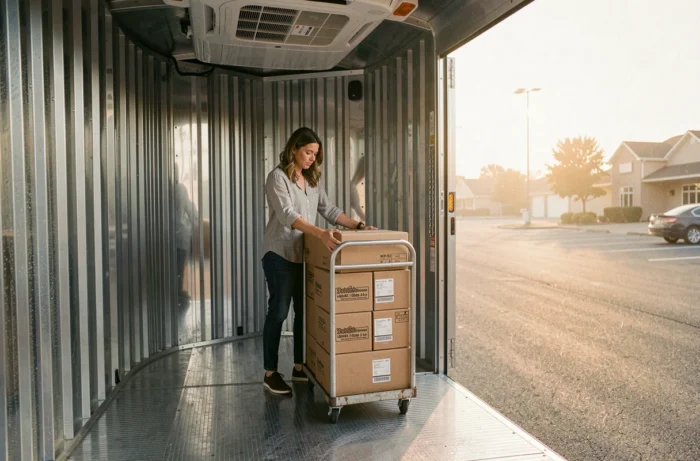
The principle is simple: prepare all the loading in advance to open only once. Arrange your boxes, bins, and cartons in the order of storage before touching the door. Load in one operation, close immediately.
For frozen goods, the constraint is even stricter. European regulations allow a rise of only 3 °C above the set temperature (i.e., a maximum of -15 °C) during loading and unloading operations. Beyond that, the product is considered to have left the cold chain.
Organizing Unloading During Service
During a buffet or festive meal, trips between the trailer and the table are frequent. Designate one person responsible for the trailer. Their role: gather requests, open once, take out several dishes at the same time, close.
Three spaced openings are better than ten close openings. Between two services, allow the refrigeration unit time to recover the temperature. In a heatwave, count on about twenty minutes with the door closed to compensate for a prolonged opening.
Official Heatwave Reminder 2026: Recommendations from the Ministry of Agriculture
Since July 7, 2026, the Ministry of Agriculture has issued a reminder aimed at food professionals, but whose advice directly applies to individuals organizing an event. The main message: minimize the time between removing items from the refrigerator and returning them to the cold.
In practical terms, this means that sensitive goods (cold cuts, dairy products, prepared dishes) should be the last to come out of the caterer’s refrigerator and the first to be loaded into the trailer. During transport, do not make intermediate stops with refrigerated products in a non-air-conditioned vehicle.
This official reminder also provides a basis for formalizing written instructions if you are organizing an event with several volunteers. A simple document displayed near the trailer, summarizing the opening rules and loading priorities, prevents individual initiatives that compromise the cold chain.
Checks When Picking Up the Super U Refrigerated Trailer
On the day of pickup, a few quick checks protect you against unpleasant surprises.
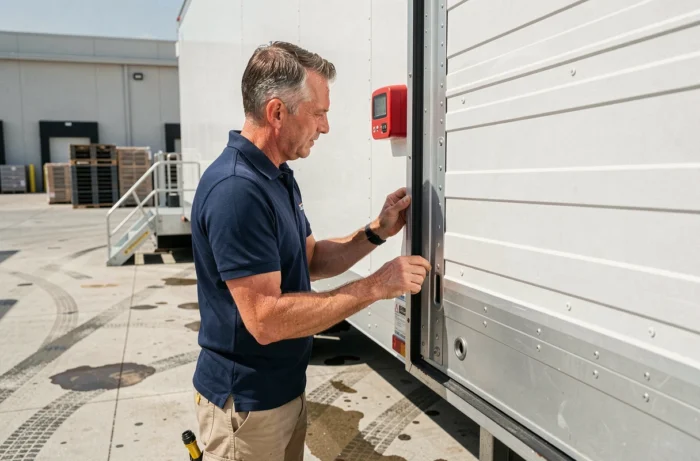
- Check the condition of the door seals: a worn or detached seal allows warm air to enter continuously. Run your hand along the frame, with the door closed and the unit running, to detect any air leaks.
- Ensure that the interior thermometer is functioning and displaying a consistent value. If the trailer does not have a built-in thermometer, bring a probe food thermometer.
- Inspect the cleanliness of the box: organic residues on the walls or floor promote cross-contamination.
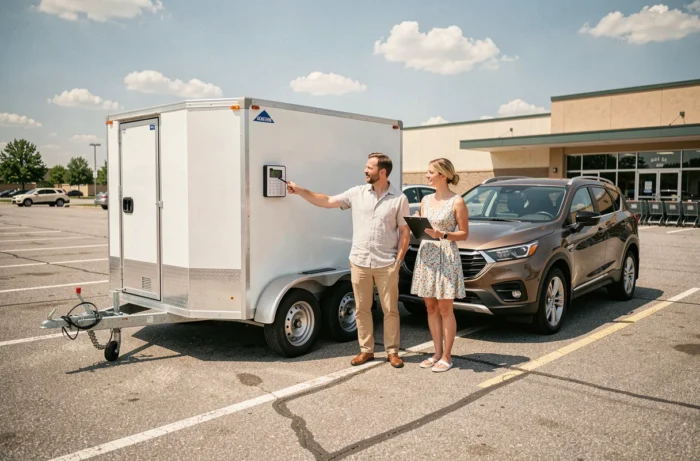
- Test the electrical connection on-site before leaving, to ensure that the refrigeration unit starts correctly.
Take photos of the condition of the trailer at pickup. In case of a dispute over the deposit (usually requested by the store), these photos serve as evidence.
The cold chain in summer does not rely on a single spectacular gesture, but on a series of ordinary precautions applied rigorously. Shaded location, dedicated electrical circuit, grouped loading, and limited openings form a coherent set. With these habits, a trailer rented from Super U fulfills its role even in high heat.