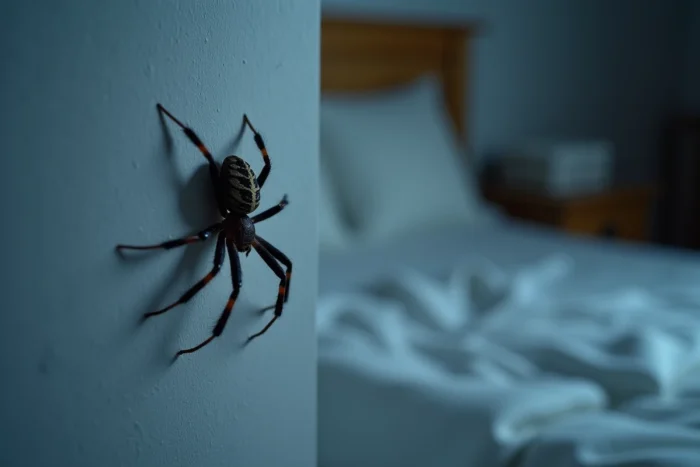
Finding a spider in the bedroom at night often triggers a disproportionate reaction compared to the actual risk. French poison control centers record an annual increase in calls regarding supposed spider bites, while confirmed cases of envenomation remain stable and very low. This gap between the fear felt and the measurable reality deserves to be examined with concrete data.
Spider bite at night: perception versus documented reality
The majority of bumps discovered upon waking and attributed to a spider come from other insects. Toxicologists associated with poison control centers and Anses have confirmed for several years: confirmed spider bites remain marginal in metropolitan France.
| Suspected cause by the patient | Identified probable cause | Relative frequency |
|---|---|---|
| Spider bite | Bed bug bite | Very frequent |
| Spider bite | Mosquito or moth bite | Frequent |
| Spider bite | Flea bite | Moderate |
| Spider bite | Actual spider bite | Rare |
This diagnostic bias has a direct consequence: blaming the spider delays the search for bed bugs or other pests that are actually present in the bed. When a skin lesion appears in the morning, the priority should be to inspect the mattress and box spring before looking for a spider on the ceiling.
If you are wondering what to do if a spider is in the bedroom, the first useful reflex is to check that the problem indeed comes from it and not from another parasite.
Heatwave and open windows: the factor that articles ignore
Existing content lists repellents and capture methods. None link the increased presence of spiders in bedrooms to recent changes in ventilation practices.
Heatwave plans encourage opening windows at night to cool homes. This nighttime ventilation creates an airflow that first attracts flying insects (mosquitoes, moths, small dipterans), and then their natural predators: spiders. Opening windows without screens is like inviting the food chain into the bedroom.
In contrast, an air-conditioned and closed home at night shows significantly fewer spider reports, not because the temperature repels them, but because their prey no longer enters.
Window screens: the only effective physical barrier
Neither peppermint nor white vinegar block the entry of a determined arthropod. A fine mesh screen installed on bedroom windows simultaneously prevents the entry of insects and spiders. It is the most reliable preventive measure, far ahead of natural repellents whose effectiveness is not rigorously documented.
- Fixed frame screen: blocks almost all arthropods, compatible with nighttime ventilation during hot periods
- Roll-up screen: practical for rentals, can be removed without drilling the frame
- Weather stripping at the bottom of doors: complements the screen by closing ground access, a frequent passage for Tegenaria
House spiders in France: three species, three nocturnal behaviors
Not all spiders seen at night in a bedroom behave the same way. Distinguishing the species allows for calibrating the reaction.
Common house spider
This is the largest house spider in France, with long legs that can span the surface of a palm. It moves quickly along walls and causes the majority of nighttime scares. The common house spider does not climb onto the bed: it hunts on the ground or in corners. Its bite, which is exceptional, is comparable to a mosquito bite.
Pholcus
The pholcus, often confused with a relative (tipula), hangs in the corners of the ceiling. It remains motionless at night on its irregular web. Its tiny body and very thin legs make it almost invisible. It feeds on other spiders, making it a natural regulator.
Steatoda
More discreet, the steatoda builds a sticky web in dark corners (behind a nightstand, under a piece of furniture). Its bite can cause moderate local pain, but documented cases in France remain rare. It is the only common domestic species that warrants some vigilance.
Nighttime reaction to a spider in the bedroom: concrete method
The most appropriate gesture depends on each person’s tolerance, but some principles are based on facts rather than fear.
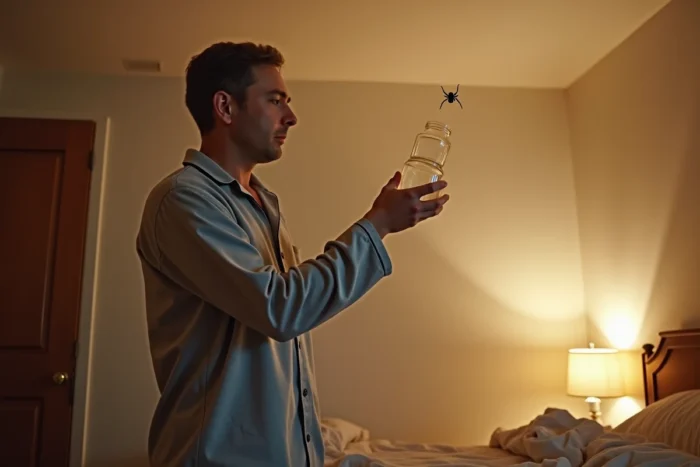
- Capture and release outside: a glass and a stiff sheet are enough. Most domestic spiders do not survive well outside, but they do not return to the same room
- Leave the spider in place if it is on its web (pholcus, steatoda): it will not move toward the bed and actively regulates harmful insects
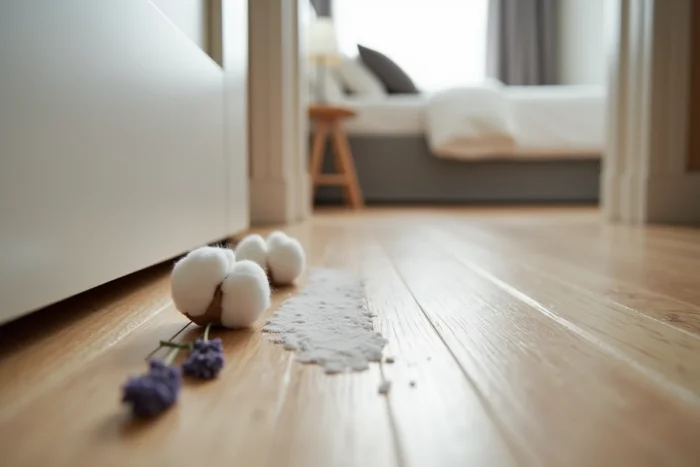
- Vacuum webs in corners once a week: this discourages establishment without resorting to chemicals
- Check around the bed in case of bumps upon waking: aligned bite marks indicate bed bugs, not a spider
Killing the spider remains the least useful option. It eliminates a predator that consumes mosquitoes, moths, and sometimes fleas, all of which are much more bothersome on a daily basis in a home.
The presence of a spider at night in the bedroom almost always indicates an influx of insects nearby. As long as the source of attraction (light, open windows without screens, accessible food) is not addressed, capturing or killing the spider solves nothing. Removing the prey is usually enough to clear the bedroom of spiders within a few weeks.