Calculating the amount of fries per person depends on a few measurable variables: the weight of raw potatoes, the cooking method, and the role of the fries on the plate (side dish or main dish). The weights also differ depending on whether you are cooking homemade fries, frozen fries, or oven fries. This article presents the available numerical data and compares them to help you portion without wasting.
Weight loss during cooking: the factor that portion calculation must integrate
Most guides reason in grams of cooked fries. The problem is that we buy raw potatoes or bags of frozen fries, not pre-prepared portions. The yield between the starting weight and the final weight changes depending on the cooking method.
A fresh potato loses water and volume once peeled, cut, and then fried or baked. Frozen fries, already partially dehydrated, lose less weight during cooking. Reasoning solely in cooked weight leads to underestimating the amount of raw material needed for homemade fries or overestimating what needs to be taken out of the freezer.
In practice, to estimate the amount of fries per person, you first need to know whether you are talking about raw potatoes to peel, frozen fries ready to cook, or already cooked fries on the plate. The table below clarifies the differences.
Table of fry portions according to profile and context
| Context | Adult portion (cooked fries) | Child portion (cooked fries) |
|---|---|---|
| Classic side (meat, fish) | 150-180 g | 80-100 g |
| Main dish (mussels and fries, burger and fries) | 220-300 g | 120-150 g |
| Brunch or light meal | about 150 g | 80 g |
| Fast food (burger combo) | 200-250 g | 100-120 g |
The standard adult portion as a side dish is between 150 and 180 g of cooked fries. When fries become the main attraction of the meal, the weight easily rises above 200 g.
For children, a range of 80 to 100 g covers most situations. Serving more almost always generates waste, especially if other side dishes are on the plate.
Homemade, frozen, or oven fries: the caloric gap that changes the reasonable portion
The weight is just one part of the equation. Caloric density varies greatly depending on the cooking method, and this parameter should influence the portion size served.
Fries plunged into a bath of oil absorb a significant amount of fat. Oven-baked or air-fried fries absorb much less. Recent content from dietitians highlights that the choice between a traditional fryer, oven, and air fryer changes the caloric load of the same weight of fries.
What this implies for portioning:
- With an oil fryer, sticking to the lower portion (150 g as a side) limits caloric intake without visible frustration on the plate.
- In the oven or air fryer, serving 180 g remains nutritionally consistent because fat absorption is reduced.
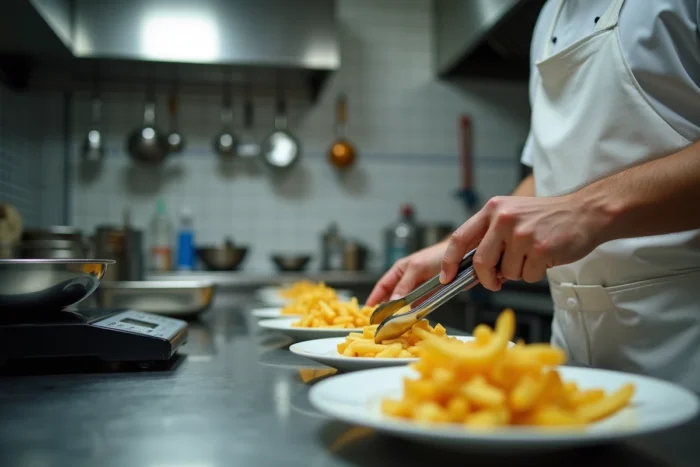
- For frozen fries baked in the oven, the convenience allows for precise weighing of each portion before cooking, which reduces waste compared to an approximate peeling of potatoes.
In other words, the cooking method determines both the reasonable portion and the appetite of the diners. Two hundred grams of fries in an air fryer do not have the same caloric weight as two hundred grams of fries submerged in oil.
Quick calculation method for a meal at home
Rather than a single weight, a two-step method avoids dosage errors, whether cooking for four or twelve diners.
Step 1: define the role of fries in the meal
If the fries accompany a protein dish (steak, breaded fish, roast chicken), start with 150 to 180 g of cooked fries per adult. If the fries are at the center of the meal (mussels and fries night, homemade burger), aim for 220 to 250 g.
Step 2: convert to raw material weight
For homemade fries from raw potatoes, plan for about one-third more weight compared to the targeted cooked weight, to compensate for peeling and water loss. For frozen fries, the ratio is closer to the final cooked weight, as the loss is less.

A concrete example: for six adults with fries as a side dish, the need is around 900 g to 1,080 g of cooked fries. In fresh potatoes, this means buying significantly more to cover losses from peeling and cooking. With frozen fries, one or two standard bags are often sufficient.
Frozen fries and waste management: an underestimated advantage
Frozen fries offer a benefit rarely highlighted in portion guides: the ability to weigh exactly what you need and put the rest back in the freezer. With fresh potatoes, we often peel too much or too little, and raw leftovers oxidize quickly.
In catering, the standardization of frozen portions helps reduce waste and stabilize costs. At home, the principle remains the same. Weighing frozen fries before cooking is the most reliable action to stick to the targeted portion.
Ultimately, the dosage of fries relies on three concrete parameters: the role in the meal, the profile of the diners (adult or child), and the cooking method. A kitchen scale and a raw weight/cooked weight conversion settle the question more reliably than any estimation by eye.