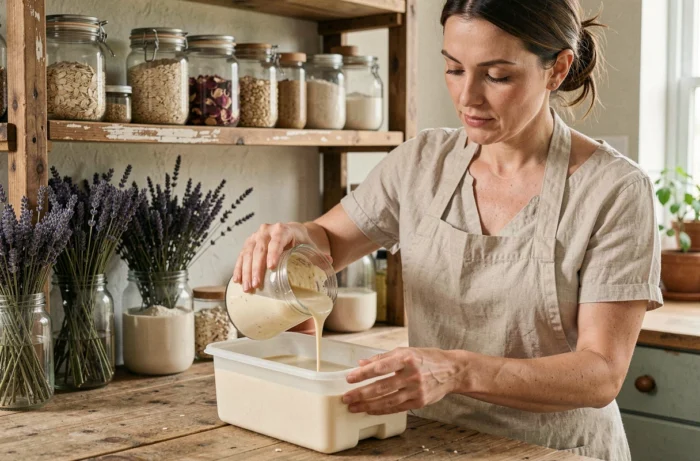
The making of homemade soap relies on a well-documented chemical reaction, saponification, which transforms fats into soap and glycerin when in contact with caustic soda. Scenting the result without using essential oils raises a specific technical question: which aromatic ingredients withstand caustic soda and retain their scent after the soap curing process?
Fragrance Allergens in Soaps: What the European Regulation of 2026 Changes
Choosing not to use essential oils does not exempt one from considering regulations on allergens. Since the implementation of regulation EU 2023/1545, the list of fragrance allergens to declare has increased from about 26 substances to over 80. The declaration thresholds remain unchanged: 0.01% for rinsed products like soaps.
This point directly concerns amateur soap makers who sell or gift their creations. Synthetic fragrances, aromatic botanical extracts (vanillin, menthol, carvone), and even some macerates contain molecules listed on this expanded list. Opting for a natural fragrance for homemade scented soap does not guarantee the absence of declarable allergens.
On the other hand, soap intended for strictly personal use is not subject to these labeling obligations. The distinction between personal production and marketing (including gifting) remains the determining criterion.
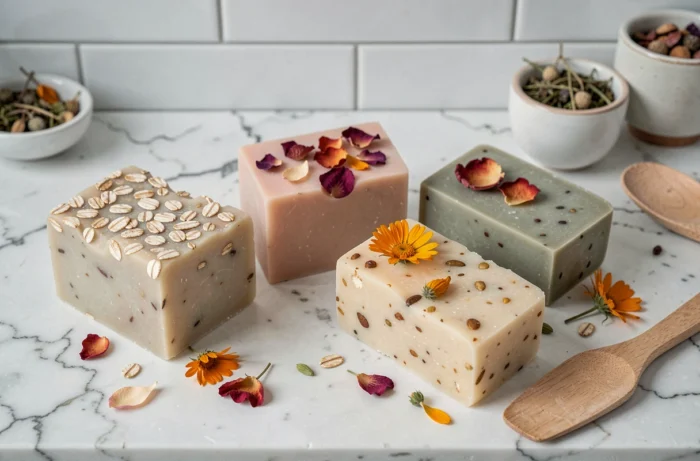
Resistance of Natural Fragrances to Cold Saponification
The main technical obstacle to scenting without essential oils lies in the saponification reaction itself. Caustic soda, mixed with water and oils, generates heat and a very high pH that degrade or alter many fragrant molecules.
Ingredients That Retain Their Scent After Curing
Some ingredients fare better through saponification than others. Field feedback varies on this point depending on recipes and dosages, but a few constants emerge.
- Plant powders (cocoa, finely ground coffee, ground cinnamon) release a subtle but persistent fragrance. Their scent withstands curing because it comes from less volatile compounds trapped in the solid matrix of the soap.
- Oil macerates (vanilla in coconut oil, lavender in olive oil) provide a subtle note. The fatty body partially protects the aromatic molecules during the reaction with caustic soda.
- Cosmetic fragrances formulated for cold saponification are designed to withstand alkaline pH. They offer the widest olfactory spectrum, but their composition is synthetic or semi-synthetic.
Hydrosols, often cited as an alternative, pose a dosage problem. Replacing part of the dilution water of the caustic soda with a hydrosol significantly reduces the final scent, as most volatile compounds are destroyed upon contact with caustic soda.
Dosage and Timing of Incorporation
The fragrance is always added at trace, never in the lye solution. Trace is the moment when the oil-lye mixture thickens enough for the blender to leave a visible imprint on the surface. Incorporating fragrant ingredients at this stage reduces their exposure time to the most aggressive pH.
For powders, a dosage of one to two tablespoons per batch of soap (about 500 g of oils) is sufficient. Beyond that, some powders like cinnamon can cause skin irritation. For cosmetic fragrances, the supplier usually indicates a maximum percentage relative to the total weight of the oils.
Recipe for Cocoa and Vanilla Scented Soap Without Essential Oils
This recipe uses cold saponification, the most common method for amateur soap makers. It produces a superfat soap, meaning it contains a fraction of unreacted oils that hydrate the skin.
Ingredients and Equipment
The base consists of olive oil (for softness), coconut oil (for lather and hardness), diluted caustic soda in water, unsweetened cocoa powder, and a vanilla macerate in coconut oil. The equipment includes an immersion blender, silicone molds, a thermometer, safety goggles, and gloves.
Caustic soda requires strict precautions: gloves, goggles, long sleeves, and a ventilated area. The lye-water mixture releases irritating vapors during the first few minutes.
Manufacturing Steps
Prepare the lye solution by slowly pouring the caustic soda into cold water (never the reverse). Allow to cool. Gently heat the solid oils until a homogeneous liquid mixture is obtained, then let it cool down.
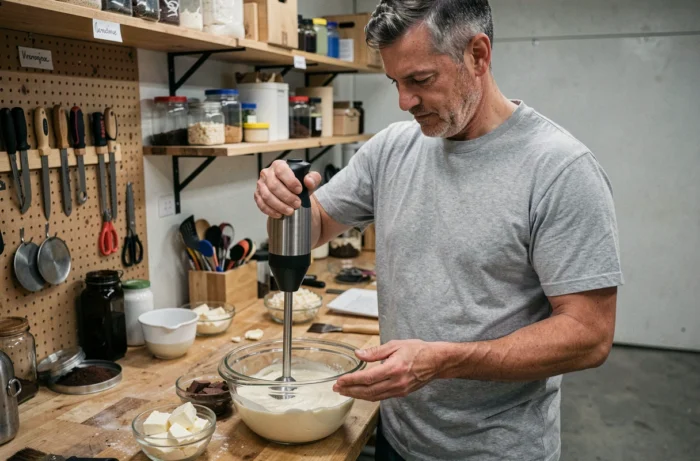
Pour the lye solution into the oils in a thin stream, blending with short pulses. When trace appears, add two tablespoons of cocoa powder and the vanilla macerate. Stir with a spoon to distribute without incorporating too much air.
Pour into the molds, cover with plastic wrap, then with an insulating cloth. Unmolding occurs after 24 to 48 hours, followed by a curing period of four to six weeks in a dry, ventilated place. This curing allows the saponification to complete and the pH to drop to a skin-compatible level.
Limitations of Scenting Without Essential Oils in Cold Saponified Soap
The scent obtained from powders or macerates remains more subtle than with essential oils or synthetic fragrances. The available data do not allow for conclusions about the exact duration of olfactory retention, which varies according to storage conditions and soap composition.
Some ingredient combinations unexpectedly alter the color of the soap. Cocoa darkens upon contact with caustic soda, resulting in dark soap. Cinnamon can create orange marbling. These variations are not defects, but they can be surprising on the first attempt.
A soap without essential oils is not automatically hypoallergenic. Cinnamon and ginger powders are among the most common skin irritants in handmade soap making. Testing each new recipe on a small skin area before regular use remains a reasonable precaution.
Cold saponification naturally produces glycerin, a humectant absent from most industrial soaps (it is removed to be sold separately). This glycerin contributes to the soft feel of homemade soap, regardless of the chosen fragrance. Whether the scent is strong or subtle, the care quality of the soap primarily depends on the choice of base oils and the superfat content.